|
http://blog.naver.com/drsangwonlee에 글을 올리면서 인사드립니다.
위 글은 부모도 반의사가 되어야 한다 www.koreapediatrics.com “
이해하기 쉽고 실용적이고 방대한 최신 정보
부모도 반의사가 되어야 한다
소아청소년(1~18세) 피부질환에서 퍼온글입니다
이상원 저작 및 저서
1. http://www.koreapediatrics.com/부모도 반의사가 되어야 한다-약 20,000여 쪽. 13412 제목, 2013년 출시 소아과 웹사이트 이상원 운영
2.소아가정의학 백과-618쪽, 1988년 출간
3.소아가정간호백과-부모도 반의사가 되어야 한다-1076쪽, 1998년 청문각 출간
4.신생아 영유아 학령기아 사춘기아 성장발육 육아-623쪽 2014년 좋은땅 출간
5.신생아 성장 발육 양호 질병, 610쪽 2014년 좋은땅 출간
6.모유 모유수유 이유 308쪽, 2014년 좋은땅 출간
7.소아청소년 뇌전증(간질)+뇌전증 백문 백답, 240쪽 2015년 좋은땅 출간
8.임신에서 신생아 돌보기까지, 약 300쪽 1998년 청문각 출간
9.아들 딸 이렇게 사랑해서 키우세요, 210쪽 역저 전 세계 명작 Ross Campbell 의학박사 저 1988년 서문당 출간
11.마약과 아이들 약 200쪽 , 1988년 출간
12.아들 딸 조건 없는 진정한 사랑으로 키우세요 그리고 인성교육은 이렇게 2016년 양서각 출간 647쪽
13.”https://www.flickr.com/people/drleesangwon
14.http://blog.naver.com/drsangwonlee
15,https://www.facebook.com/drleesangwon
16.Newyorkkorea.netd의 Pediatric columnist
17.그 외
위 포스팅 내용의 대부분은 www.koreapediatrics.com에 있는 내용들입니다. 전문적인 면도 있지만 소아청소년 자녀 양육에 많은 도움이 되리라고 믿습니다. 그러나 여기에 있는 정보는 여러분의 의사로부터 얻는 정보와 치료를 대신할 수 없습니다. www.koreapediatrics.com 부모도 반의사가 되어야 한다
저자 이상원
연세대학교 의과대학 졸업
무의촌 2년간 봉사 및 대한민국 군의관 3년 근무
미국 커네티컷 UCONN 의과대학, 예일대학교 의과대학 소아과 수련
미국 소아과 전문의, 한국 소아청소년과 전문의
American Top pediatrician 2002~2005
미국 커네티컷 주 의사면허증 #016370
한국 의사면허증 #7794
Copyrightⓒ 2017 John Sangwon Lee, MD.FAAP
■인성교육-아들 딸 조건 없는 진정한 사랑으로 키우세요 그리고 인성교육은 이렇게 양서각 참조
Copyright drleepediatrics.com 2/28/2026
Psoriasis
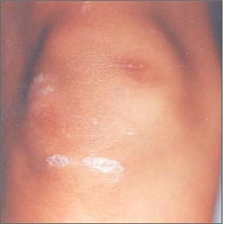
▴ Photo 541. Psoriasis on the knee
Copyright ⓒ 2012 John Sangwon Lee, MD, FAAP
▴ Photo 542. Psoriasis on the elbow
Copyright ⓒ 2012 John Sangwon Lee, MD, FAAP
▴ Photo 544. Psoriasis affecting the fingernails
Copyright ⓒ 2012 John Sangwon Lee, MD, FAAP
■ Overview of Psoriasis
● Psoriasis is defined as a chronic, inflammatory, systemic disease characterized by dry, erythematous patches covered in scales; it is a non-contagious, autoimmune skin disorder.
● Approximately one-third of adult psoriasis patients experience the onset of the disease at age 16 or earlier.
● Psoriasis can result in physical impairments, create visible cosmetic blemishes that draw the attention of others, and lead to psychological issues.
● It may be accompanied by associated conditions such as depression, obesity, myocardial infarction, and metabolic disorders (Source: NEJM, January 17, 2008).
■ Types of Psoriasis
Based on age, psoriasis is classified into several types, as follows: ① Congenital psoriasis,
② Neonatal psoriasis,
③ Pediatric psoriasis,
④ Adult-onset psoriasis, etc.
■ Types of Psoriasis Based on Morphology and Affected Body Regions
① Pustular psoriasis
② Guttate psoriasis
③ Erythrodermic psoriasis
④ Psoriasis vulgaris
⑤ Plaque psoriasis
⑥ Inverse psoriasis
⑦ Palmar and plantar psoriasis
■ Causes and Epidemiology of Psoriasis
● It is estimated that approximately 125 million people worldwide suffer from psoriasis. This condition causes both mental and physical distress, and patients sometimes also suffer from associated complications such as psoriatic arthritis or cardiometabolic diseases. Source: JAMA, May 19, 2010.
● The exact cause of psoriasis remains unknown.
● Similar to the causes of juvenile rheumatoid arthritis or Crohn’s disease, it is believed to arise from an autoimmune dysfunction.
● The majority of pediatric psoriasis cases are hereditary conditions linked to specific human leukocyte antigen (HLA) alleles: B13, A2, and CW6. Consequently, individuals with a family history—specifically, if a family member has previously had psoriasis—are at risk of developing the disease. It is also believed to be mediated by T-cells.
● Approximately 2% of all psoriasis cases manifest before the age of two (Contemporary Pediatrics, June 2008, p. 30).
● In the field of pediatric dermatology, psoriasis accounts for 10% of all diagnosed skin conditions.
● In some cases—particularly among adolescents—the condition manifests severely on the arms and legs, and may subsequently spread to the torso.
● For adolescents in particular, the onset of psoriasis can lead to depression and may also result in academic difficulties or learning impairments. ● If psoriatic lesions cover more than 10% of the body’s total skin surface area, the condition is classified as severe psoriasis.
● It is estimated that 31% to 45% of adult psoriasis patients experienced the onset of the disease during childhood.
● Psoriasis can occur even during the neonatal period.
● Psoriasis can manifest as silvery scales.
● Childhood psoriasis may present with itching; unlike the form seen in adults, the patches associated with childhood psoriasis are often very small, which can make diagnosis challenging.
● Guttate psoriasis may develop following a streptococcal infection; additionally, psoriasis—or psoriatic diaper dermatitis—can occur in the diaper area of newborns and infants.
● Psoriasis may appear on the face, trunk, elbows, knees, diaper area, scalp, and fingernails (the incidence of nail psoriasis is approximately 40%).
● If psoriatic lesions become infected and suppurate, they may resemble impetigo; in some cases, they may also present in an annular (ring-like) pattern.
● Psoriasis can affect the nails, potentially causing pitting, discoloration (either darkening or lightening), and subungual hyperkeratosis (thickening of the skin beneath the nail).
● Approximately 5% of psoriasis patients also have atopic dermatitis. Scalp psoriasis typically presents with silvery scales and erythematous (red, inflamed) skin on the scalp; it is common for psoriasis to be present on other parts of the body as well.
■ Diagnosis of Psoriasis
● Diagnosis is established by comprehensively evaluating the patient’s medical history, signs and symptoms (particularly family history), and physical examination findings.
● When necessary, bacterial or fungal cultures are performed to differentiate psoriasis from infectious skin diseases.
● In some cases, a biopsy (tissue sampling) is performed to confirm the diagnosis. ● It must be differentiated from conditions such as seborrheic dermatitis, atopic dermatitis, Langerhans cell histiocytosis, and acquired immunodeficiency syndrome (AIDS/HIV infection).
■ Treatment of Psoriasis
● Treatment may involve the use of corticosteroid ointments or lotions.
● Treatment modalities include tar preparations, anthralin, salicylic acid, calcipotriol ointment, or ultraviolet B (UVB) light therapy.
● Treatment may involve agents such as tacrolimus, as well as high-potency corticosteroid ointments combined with calcipotriene cream.
● Treatment of Mild Psoriasis
Psoriasis affecting 3–5% or less of the total body surface area—including cases accompanied by psoriatic arthritis—is treated using topical corticosteroids, topical vitamin D analogs (such as calcipotriene), topical tazarotene, salicylic acid preparations, or phototherapy.
● Treatment of Moderate to Severe Psoriasis
Treatment involves the use of UV-B, PUVA, TNF-α inhibitors, IL-12/23 inhibitors, IL-17 inhibitors, IL-23 inhibitors, and oral systemic medications.
● Nail psoriasis is treated with oral corticosteroids or ultraviolet light therapy; in very severe cases, it is treated with Methotrexate, Retinoids, or Cyclosporine.
● A recent study reported that treating psoriasis with Etanercept—a medication used to treat juvenile rheumatoid arthritis or Crohn’s disease—via weekly injections over a 12-week period was effective in 75% of patients (Source: NEJM, January 17, 2008, p. 241). Source: *Consultant for Pediatricians*, Sep. 2008.
● Psoriasis is defined as a chronic, inflammatory, systemic disease characterized by dry, erythematous patches covered in scales; it is non-contagious and is classified as an autoimmune skin and joint disorder.
● It is reported that 33% of adult psoriasis patients experience disease onset during childhood or adolescence—specifically, at age 16 or earlier.
● Psoriasis results in physical impairments.
● It causes visible blemishes on the skin that are noticeable to others.
● It can also lead to psychological issues.
● Furthermore, it may be accompanied by conditions such as depression, obesity, myocardial infarction, or metabolic disorders (Source: NEJM, January 17, 2008, p. 241). ● Autoimmune diseases such as Crohn’s disease, rheumatoid arthritis, psoriasis, ankylosing spondylitis, and psoriatic arthritis can be treated with Infliximab (Remicade). Source: Journal Watch, The NEJM, Nov. 2010
The FDA approves risankizumab as a treatment for plaque psoriasis. Source: 4/24/2019 AMA Morning Rounds
Greetings! I am posting this entry on my blog at http://blog.naver.com/drsangwonlee.
The text above is excerpted from *Parents, You Too Must Become Half-Doctors* (www.koreapediatrics.com).
— Comprehensive, up-to-date information that is both practical and easy to understand —
*Parents, You Too Must Become Half-Doctors*
This post was excerpted from the section on skin diseases in children and adolescents (ages 1–18).
**Works and Publications by Lee Sang-won**
1. *Parents, You Too Must Become Half-Doctors* — Approx. 20,000 pages, comprising 13,412 entries. Launched in 2013; a pediatrics website operated by Lee Sang-won.
2. *Encyclopedia of Pediatric Family Medicine* — 618 pages; published in 1988.
3. *Encyclopedia of Pediatric Home Nursing: Parents, You Too Must Become Half-Doctors* — 1,076 pages; published by Cheongmungak in 1998.
4. *Growth, Development, and Parenting: From Newborns and Infants to School-Aged and Adolescent Children* — 623 pages; published by Joeunttang in 2014.
5. *Newborns: Growth, Development, Care, and Illnesses* — 610 pages; published by Joeunttang in 2014.
6. *Breast Milk, Breastfeeding, and Weaning* — 308 pages; published by Joeunttang in 2014.
7. *Pediatric and Adolescent Epilepsy (Seizures) + 100 Questions and Answers on Epilepsy* — 240 pages; published by Joeunttang in 2015.
8. *From Pregnancy to Newborn Care* — Approx. 300 pages; published by Cheongmungak in 1998.
9. *Raise Your Sons and Daughters with Love* — 210 pages. A translated work (Korean edition) of the world-renowned classic by Dr. Ross Campbell; published by Seomundang in 1988.
11. *Drugs and Children* — Approx. 200 pages; published in 1988. Publications
12. *Raise Your Sons and Daughters with True, Unconditional Love—And Here Is How to Teach Character Education* (Published by Yangseogak, 2016; 647 pages)
13. https://www.flickr.com/people/drleesangwon
14. http://blog.naver.com/drsangwonlee
15. https://www.facebook.com/drleesangwon
16. Pediatric Columnist for Newyorkkorea.net
17. Other Activities
Most of the content in the above post is sourced from www.koreapediatrics.com. While the material contains professional medical aspects, I believe it will be of great assistance in raising your children and adolescents. However, the information provided here cannot serve as a substitute for the advice and treatment you receive from your own physician. (www.koreapediatrics.com: “Parents, Too, Must Become Half-Doctors”)
Author: Lee Sang-won
Graduated from Yonsei University College of Medicine
Served for two years in underserved rural areas and three years as a military physician in the Republic of Korea Armed Forces
Completed pediatric residency training at the University of Connecticut (UCONN) School of Medicine and Yale University School of Medicine (USA)
Board Certified Pediatrician (USA); Board Certified Pediatrician (Korea)
Recognized as an “American Top Pediatrician” (2002–2005)
Connecticut State Medical License No. 016370 (USA)
Medical License No. 7794 (Korea)
Copyright © 2017 John Sangwon Lee, MD, FAAP
■ Character Education: *Raise Your Sons and Daughters with True, Unconditional Love—And Here Is How to Teach Character Education* (Refer to the book published by Yangseogak)
Copyright: drleepediatrics.com (Last Updated: 2/28/2026)
|