
개에 물린 상처(견 교상) Dog bites 개에 물렸을 때(견 교상)의 개요
◆ 미국 의료 응급실 안전사고 응급치료 현항
2005년, 천 1백 8십만 명이 급성 피부 손상으로 병원 응급실에서 치료받았다.
● 그 중 5십만 명 이상이 화상 치료를 받았고,
● 7백 3십만 명이 절상 치료를 받았고,
● 2백만 명이 자상과 절상 치료를 받았다.
● 매년 4백70만 명이 동물에 물렸다(Animal bites/동물 교상). 출처: NEJM Sep 2008 p.1037. 세계적으로 천만 명이 개에 물린다고 한다. JAMA June 23/30 2020.
● 소아청소년(0-18세)이 주인 없이 방황하는 낯선 개, 자기 집 개나 이웃집 개에게 물려 심한 견교상 상처를 입을 수 있다. 특히 두 마리 이상을 기르면 그런 개가 물기가 더 쉽다.
● 개에 물려 타박상, 자상, 절상 등 견교상 상처를 입을 수 있고, 그 외 다른 여러 가지 상처를 입을 수 있고 개에 물려 죽을 수도 있다.
● 고양이에 물리면 깊은 자상이 생기기 쉬우나 개에 물리면 개방 절상 상처가 더 잘 생긴다(NEJM Sep 2008 p1037).
● 심하게 물린 견 교상 상처로 인해 죽기도 하고,
● 때로는 개에 물린 교상 상처에 개 입속 세균에 감염되어 물린 상처가 곪을 수 있고 드물게 광견병에 걸려 죽기도 한다.
● 물린 상처가 다 나은 후에 흉터가 심하게 생길 수 있고 그로 인해 일생 동안 심리적 고통을 받을 수 있다.
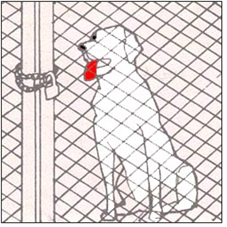
▴ 그림 367. 문 개를 약 10일간 개장에 가두고 광견병(공수병)을 앓고 있는지 광견병의 증상 징후가 발생하는지 관찰한다.
Copyright ⓒ 2011 John Sangwon Lee, MD, FAAP

▴ 사진 366. 개에 물리지 않도록 교육시킨다.
Copyright ⓒ 2011 John Sangwon Lee, MD, FAAP.
미 NCIPC 통계에 의하면, 미국에서는 연간 약 4.7백만 명이 개에 물린다고
한다. 그중 800,000명이 응급치료를 받았고 그중 반 정도는 소아청소년들이었다. 개에 물려 생긴 견 교상 상처를 치료받는 데 소요된 총 의료비는 연간 2억 불이었다.
● 미국에서는 연간 17명이 개에 물려 죽었다. 참조문헌.
● 여아들보다 남아들이 개에 더 잘 물린다.
● 개에 물린 소아청소년들의 50% 이상이 4세 이전의 영유아들이다.
● 나이가 어리면 어릴수록 개에 더 심하게 물린다.
● 미국에서는 총 응급실 방문 환자들의 0.85%가 개에 물린 환자이다.
● 주인이 없이 혼자 방황하는 낯선 개에 물리는 경우보다 대부분의 경우는 자기 집 개나 이웃집 개에 더 잘 물린다.
● 주로 자기 집이나 자기 집 주위에서 개에 물리고 자기 개에 물리는 경우가 90% 정도이다.
● 학령기 아이들, 사춘기 아이들이나 성인들은 개가 물려고 대들 때 대드는 개의 공격을 팔이나 다리로 직접 막는 습성이 있기 때문에 그들의 손, 팔, 또는 다리 부위가 더 잘 물리고 그 다음으로 두부나 얼굴 부위, 그 다음으로 몸통이 더 자주 물린다.
● 그 반면에 개가 물려고 대들 때 영유아들은 개의 공격에 속수무책이기 때문에 머리, 얼굴, 몸통 등 부위를 더 자주 물린다.
● 개에 이빨 자국만 조금 나게 물릴 수 있고, 피부 층과 피하가 전부 찢기고, 심하면 살덩어리가 떨어져 나갈 정도로 심하게 개에 물릴 수 있다.
● 개에 물려서 찰과상, 자상, 타박상, 열상 등 상처가 생길 수 있다.
● 드물게 개한테 크게 물려 상처와 출혈로 쇼크에 빠지고 현장에서 죽기도 한다.
■ 개에 물렸을 때 증상 징후
● 개에 물린 상처의 너비와 깊이, 물린 상처 수, 물린 신체 부위, 물린 후 생긴 상처 감염병의 유무에 따라 증상 징후가 다르다.
● 물릴 때 개 입속에 있던 여러 종류의 비호기성 박테리아가 개에 물린 상처에 감염되어 물린 상처가 흔히 곪는다.
● 개에 물린 상처의 약 5~10%가 박테리아에 감염된다. 다른 연구에 의하면 3~18% 감염된다고 한다(출처: NEJM Sep 2008 p.1037).
● 개에 물린 후 가장 흔히 감염병을 일으키는 세균은 황색 포도상구균(Staphylococcus aureus)과 Pasteurella multocida이다.
● 그 외 다른 종류의 포도상구균, 연구균군 Streptococcus group , 카니모루스(Cani-morus), 박테로이드(Bacteroides), 프리보텔라(Prevotella) 등 호기성 박테리아나 비호기성 박테리아가 감염될 수 있다.
● 개에 물린 상처가 곪을 때는 봉소염, 종기, 림프관염, 림프절 비대와 림프절염 등이 생길 수 있다. 드물게는 골수염, 관절염, 패혈증, 뇌막염, 심내막염 등 위중한 합병증이 생길 수 있다.
● 개에 물린 상처가 곪아서 봉소염(연조직염/봉와염)이 생기면 물린 상처가 빨갛다. 붓고, 아프고, 물린 상처를 만지면 따뜻한 감이 있고, 상처에 고름이 잡힐 수 있고, 고름이 날 수 있다.
● 개에 물려 복잡하게 찢어지고 심하게 찢어진 열상(절상)이나 자상을 적절히 치료받지 않으면 물린 상처의 100%가 곪을 수 있고, 물린 상처가 다 나은 후에 흉터가 흉하게 생길 수 있다.
● 개에 물리기 전이나 물린 후 파상풍 백신 권장 접종을 받지 않았으면 개에 물린 후 파상풍 백신 예방 접종을 받는다.
● 미친개에 물리면 광견병에 걸릴 수 있다.
■ 개에 물린 상처의 진단과 광견병 예방 접종
● 개에 물린 상처가 경미해도 의사에게 문의 진단 치료를 곧 받아야 한다.
● 특히, 주인 없이 방황했던 낯선 개에 물렸을 때나 문 개가 광견병 백신을 권장한 대로 접종받았는지 확실히 알아보아야 한다.
● 문 개가 광견병 백신으로 광견병 예방 접종을 받았는지 확실히 모를 때는 의사의 지시에 따라 문 개를 적어도 10일 정도 개장에 가두고 광견병의 증상이 있는지 또는 생기는지 관찰한다.
● 문 개가 광견병에 걸린 것 같거나 광견병의 증상 징후가 조금이라도 나타나면 그 개를 즉시 죽여 개 뇌 조직 생체 검사를 해야 한다.
● 이런 사실을 보건당국이나 단골 소아청소년과에 즉시 보고하고 적절한 추적 치료를 받는다.
■ 개에 물린 상처의 치료
● 개에 물린 상처의 크기와 개의 건강 상태에 관계없이 일단 의사에게 문의하여 응급치료를 받아야 한다.
● 주인 없이 거리를 방황하는 낯선 개, 건드리지도 않았는데 문 개, 광견병 예방접종 백신을 한 번도 접종받지 않은 개에게 물렸을 때는 그 문 개가 광견병에 걸려있지 않다는 것을 확인할 때까지 문 개를 미친개로 취급하는 것이 보통이다.
● 그런 개에 물린 환아는 의사의 지시에 따라 광견병(공수병) 백신으로 광견병 예방 접종을 받고, 가능 하면, 문 개를 약 10일 동안 개장에 잡아 가두고, 광견병 증상 징후가 있는지 나타나는지 조심히 관찰한다.
● 문 개가 광견병에 걸린 것 같거나 광견병에 걸렸을 경우는 그 문 개를 잡아 죽이고 개 뇌 조직 생체 검사를 한다.
● 개에 물려 생긴 작은 자상이나 개 이빨로 긁힌 상처는 이차 유합(Secondary intention) 치료를 한다.
● 의사의 지시에 따라, 개에 물린 상처를 가능한 한 비눗물로 깨끗이 씻은 후 베타다인액 살균제나 다른 종류의 살균제로 살균치료를 한 후 국소용 항생제 연고를 바르고 깨끗한 무균 거즈로 덮어 치료하던지, 때로는 환부를 덮어 치료를 하지 않고 공기 노출 치료를 한다.
● 물린 상처가 잘 낫는지, 물린 상처가 곪는지 매일 관찰 치료를 한다.
● 위에서 설명했지만, 개에 물린 후 바로 병원 응급실이나 단골 소아청소년과 의사에게 전화해서 그들의 지시에 따라 부모가 일차적 최초 응급치료를 할 수 있다.
● 개에 물린 상처가 아무리 작아도, 문 개의 입속에서 상존하는 비호기성 박테리아가 물린 상처 깊숙이 감염되어 상처가 잘 곪을 수 있다.
● 모든 견 교상을 곪지 않게 항생제 예방 치료를 통상적으로 하라고 권장하지는 않지만 특히 개에 물린 상처가 손이나 발에 있을 때, 골, 관절, 건 등에 있을 때, 깊이 물린 견 교상 상처, 심하게 물린 견 교상 상처, 개 물린 상처가 이미 곪았으면 의사의 처방에 따라 아그멘틴(Augmentin), Cefuroxime, 또는 Clindamycin + Septra 등 광범위 항생제 중 한 종류 또는 두 종류의 항생제로 개 물린 상처가 곪지 않게 예방 치료를 하고, 또 곪았을 때도 그런 종류의 항생제로 적절히 치료하는 것이 보통이다 3-참조문헌.
● 개에 물린 상처가 크고 지저분하고 박테리아에 이미 감염됐다고 의심되면 바로 봉합수술로 치료하지 않고 3~5일 동안 상처 개방 관찰 치료를 하면서 3차 유합(Tertiary intention) 치료를 한다.
● 개에 물린 상처를 봉합 수술치료를 받지 않은 개방 상태로 치료받다가 상처가 다 아문 다음에 상흔을 성형수술 치료를 받을 때도 있다(출처; NEJM sep 2008 p.1037).
● 개가 물고 도망쳤을 때나, 문 개가 광견병에 결렸다고 의심될 때, 미친개에 물렸을 때는 광견병 백신 예방접종을 받고 광견병 면역 글로불린 주사로 광견병을 예방접종 받도록 권장한다.
● 파상풍 예방접종 백신을 권장한 대로 접종한다([부모도 반의사가 되어야 한다-소아가정간호백과]-제7권 소아청소년 감염병 질환-광견병 참조).
표 45. 짐승에 물렸을 때 광견병 예방접종 방법
|
짐승의 종류 |
물은 짐승의 건강 상태 |
치료 |
|
여우, 박쥐, 완웅, 호랑이 등 야생짐승 |
뇌 생체조직 검사를 하여 미치지 않은 짐승이라고 확인하기 전에는 미친 짐승으로 간주한다. |
Rhrig + HDCV으로 치료한다. |
|
가축 |
건강하고 관찰할 수 있을 때 |
광견병 예방접종을 해 줄 필요가 없다. |
|
개, 고양이 등 애완동물 |
물고 도망친 경우나 미쳤거나 또는 미친 것 같을 때 |
Rhrig + HDCV으로 치료한다. |
|
그 밖의 가축, 토끼, 쥐 등 |
– |
경우에 따라 광견병 예방접종을 받는다. |
주석
● HRIG : 사람 광견병 면역 글로불린(Human rabies immunogloblin)
● HDCV(Imovax): 사람 세포로 배양한 광견병 바이러스 예방접종 백신.
● 도표에서 제시한 대처 방안은 일반적이다. 따라서 짐승에 물렸을 때는 꼭 단골 의사의 지시에 따라 광견병을 예방한다.
■ 출처 및 참조문헌
● Reproduced by Permission from: Report of the Committee on Infectious Diseases, 12th Edition, American Academy of Pediatrics, 소아가정간호백과, 이상원 저. 청문각과 그 외
● The Manual of Emergency Pediatrics, 4th edition, Robert M. Reece, M.D., p.246-247,376-377,480-481
● Emergency Pediatrics, A guide to ambulatory care, 5th edition. Roger M. Barkin, Peter Rosen, p.303-306
● Quick Reference to Pediatric Emergencies, Delmer J. Pascoe, M.D., Mose Grossman, M.D., p.261-263
● Emergency care and transportation of the sick and injured, 3rd edition, American Academy of Orthopaedic Surgeons. p.331
● Nelson textbook, 14th edition p.1795-1796
● The Johns Hopkins Hospital, The Harriet Lane Handbook, 18th edition, pp 107-109
● JAMA June 23/30 2020
● 그 외
여기 정보는 ‘부모도 반의사가 되어야 한다 www.koreapediatrics.com
소아과 웹사이트 총 25권 중 제1권 ‘소아청소년 응급의료’ 에서 퍼 온 글
인사 드립니다.
안녕하세요
온 세상 한국 부모님 여러분!!!!!!!!!!!!
전 세계 8천만 한인 필독 진정한 육아 바이블 읽기 운동에 동참해 주시기를 바랍니다.
미국 소아과전문의, 한국 소아청소년과 전문의 이상원 Dr. John Sangwon
Lee, MD, FAAP 는 고국과 전 세계 8천 만 한인들에게 자녀 육아, 건강증진,
질병진단 치료, 예방, 자녀를 진정으로 사랑하는 방법, 수면, 소아청소년 성교육, 인성교육 등에 관한 자녀 육아 필독 바이블을 온 세상 8천만 한인들에게 선물로 다음 정보들을 드리고 싶습니다.
1. http://www.koreapediatrics.com/부모도 반의사가 되어야 한다-약 20,000여 쪽. 13412 제목, 2013년 출시 소아과 웹사이트
2.소아가정의학 백과-618쪽, 1988년 출간,
3.소아가정간호백과-부모도 반의사가 되어야 한다-1076쪽, 1998년 출간,
4.신생아 영유아 학령기아 사춘기아 성장발육 육아-623쪽 2014년 출간,
5.신생아 성장 발육 양호 질병, 610쪽 2014년 출간
6.모유 모유수유 이유 308쪽, 2014년 출간
7.소아청소년 뇌전증(간질)+뇌전증 백문 백답, 240쪽 2015년 출간
8.임신에서 신생아 돌보기까지, 약 300쪽 1998년 출간
9.아들 딸 이렇게 사랑해서 키우세요, 210쪽 역저 전 세계 명작 Ross Campbell
10.의학 박사 저 1988년 출간
11.,마약과 아이들 약 200쪽 , 1988년 출간
12.아들 딸 조건 없는 진정한 사랑으로 키우세요 그리고 인성교육은 이렇게 2016년 출간 647쪽
13.”https://www.flickr.com/people/drleesangwon
14. “http://blog.naver.com/drsangwonlee”
15,”https://www.facebook.com/drleesangwon“
16.Newyorkkorea.netd의 Pediatric columnist
17. 그 외
고국과 전 세계 한인 남녀 노소 여러분의 삶의 기본 필 수조건 중 하나인 건강증진을 위해 어디선지 언제든지 누구든지 쉽게 접해서
읽을 수 있는 한글 건강 증진 정보가 들어 있는 육아 정보 바이블이 필요한때가
한 세기 이상 지났다고 생각합니다.
여유가 있으면 전 세계 한인 각 가정에 육아 바이블을 전부 증정하고 싶습니다.
시간이 있으면 사랑하는 한인 부모님들께 육아 바이블 전부를 크게 소리 내어
읽어 드리고 싶습니다.
물론 부족한 면도 있을 수 있습니다. 다른 육아 바이블을 참조하면서 자녀들을 육아하면 자녀들은 분명히 행복하게 자랄 것이라고 저는 확신합니다.
이상원 드림
미국 커네티컷 주 의사면허증 #016370
한국 의사면허증 #7794
미국 소아과학회 명예회원
한국소아청소년과 전문의
미국 Top 소아과 전문의
Copyrightⓒ 2017 John Sangwon Lee, MD.FAAP
Sangwon Lee
Sangwon Lee님은 Facebook 회원입니다. Facebook에 가입하여 Sangwon Lee님 등 다른 친구들을 만나세요. Facebook은 활발한 정보 공유를 통해 보다 친밀하고 열린 세상을 만듭니다.
www.facebook.com
Copyright drleepediatrics.com 3/3/2026
Dog Bites (Canine Bites) | Overview of Dog Bites
Parents Are Half-Doctors | July 5, 2017, 8:53 AM
Copy URL | Statistics
Dog Bites (Canine Bites) | Overview of Dog Bites
◆ Current Status of Emergency Care for Accidents and Injuries in U.S. Emergency Departments
In 2005, 11.8 million people received treatment in hospital emergency departments for acute skin injuries.
● Of these, more than 500,000 people were treated for burns;
● 7.3 million people were treated for lacerations; and
● 2 million people were treated for puncture wounds and cuts.
● Every year, 4.7 million people are bitten by animals (Animal bites). Source: NEJM, Sep 2008, p. 1037. Globally, it is estimated that 10 million people are bitten by dogs annually. JAMA, June 23/30, 2020.
● Children and adolescents (ages 0–18) are at risk of sustaining severe dog bite injuries—whether from stray dogs wandering without an owner, their own family dogs, or a neighbor’s dogs. This risk is particularly high in households that keep two or more dogs, as such dogs are more prone to biting.
● Dog bites can result in various injuries—including contusions, puncture wounds, and lacerations—and may even prove fatal.
● While cat bites tend to result in deep puncture wounds, dog bites are more likely to cause open lacerations (NEJM, Sep 2008, p. 1037).
● Severe dog bite wounds can, in some cases, prove fatal.
● At times, a bite wound may become infected by bacteria present in the dog’s mouth, causing the wound to fester; in rare instances, the victim may contract rabies and die.
● Even after the bite wound has fully healed, it may leave behind severe scarring, potentially causing the victim to suffer from psychological distress for the rest of their life.
▴ Figure 367. The dog responsible for the bite should be confined in a cage for approximately 10 days and observed to determine whether it is suffering from rabies (hydrophobia) or exhibiting any signs or symptoms of the disease.
Copyright ⓒ 2011 John Sangwon Lee, MD, FAAP
▴ Photo 366. Children should be educated on how to avoid being bitten by dogs.
Copyright ⓒ 2011 John Sangwon Lee, MD, FAAP.
According to statistics from the U.S. NCIPC (National Center for Injury Prevention and Control), approximately 4.7 million people in the United States are bitten by dogs each year.
Of these cases, 800,000 individuals sought emergency medical treatment, and roughly half of them were children or adolescents. The total medical cost incurred for treating dog bite wounds amounted to $200 million annually.
● In the United States, an average of 17 people die each year as a result of dog bites. (Reference)
● Boys are more likely to be bitten by dogs than girls.
● More than 50% of the children and adolescents bitten by dogs are infants or toddlers under the age of four.
● The younger the child, the more severe the resulting dog bite injury tends to be.
● In the United States, patients presenting with dog bites account for 0.85% of all emergency room visits.
● In the majority of cases, victims are bitten by their own dogs or a neighbor’s dog, rather than by a stray or unfamiliar dog wandering alone without an owner.
● Most dog bites occur within or immediately surrounding the victim’s own home; approximately 90% of these incidents involve the victim’s own dog.
● School-aged children, adolescents, and adults tend to instinctively use their arms or legs to directly fend off an attacking dog when it lunges to bite; consequently, their hands, arms, or legs are the most frequently bitten areas, followed by the head or face, and then the torso.
● Conversely, infants and toddlers are defenseless against a dog’s attack when it lunges to bite; as a result, they are more frequently bitten on areas such as the head, face, and torso.
● Dog bites can range in severity from minor nicks that leave only tooth marks to injuries where the skin layers and subcutaneous tissue are completely torn, or, in severe cases, injuries so extreme that chunks of flesh are torn away.
● Dog bites can result in various types of injuries, including abrasions, puncture wounds, contusions, and lacerations.
● In rare instances, a severe dog bite can lead to shock caused by extensive injury and blood loss, resulting in death at the scene.
■ Signs and Symptoms of a Dog Bite
● The signs and symptoms of a dog bite vary depending on the width and depth of the wound, the number of bite wounds, the specific body part bitten, and the presence or absence of a wound infection following the bite.
● During a bite, various types of anaerobic bacteria present in the dog’s mouth can infect the wound, frequently causing the bite site to become purulent (to fester).
● Approximately 5–10% of dog bite wounds become infected with bacteria. According to other studies, the infection rate ranges from 3% to 18% (Source: NEJM, Sep 2008, p. 1037).
● The bacteria most commonly responsible for causing infections following a dog bite are *Staphylococcus aureus* and *Pasteurella multocida*.
● Other types of bacteria—including various *Staphylococcus* species, *Streptococcus* group bacteria, *Canimorsus*, *Bacteroides*, and *Prevotella*—whether aerobic or anaerobic, may also cause infection.
● If a dog bite wound becomes infected, complications such as cellulitis, boils, lymphangitis, lymphadenopathy (enlarged lymph nodes), and lymphadenitis may develop. In rare cases, severe complications—including osteomyelitis, arthritis, sepsis, meningitis, and endocarditis—may occur.
● If a dog bite wound becomes infected and leads to cellulitis (a soft tissue infection), the bite site will appear red. It may become swollen and painful; feel warm to the touch; and potentially accumulate pus or discharge.
● If complex, severe lacerations or puncture wounds resulting from a dog bite do not receive appropriate medical treatment, there is a 100% risk of infection; furthermore, the wound may heal with unsightly scarring.
● If you have not received a recommended tetanus vaccination—either prior to or following the incident—you should receive a tetanus booster shot after being bitten by a dog.
● Being bitten by a rabid dog carries the risk of contracting rabies.
■ Diagnosis of Dog Bites and Rabies Vaccination
● Even if a dog bite wound appears minor, you should consult a physician immediately to receive a diagnosis and treatment.
● In particular, if you are bitten by a stray dog wandering without an owner, or if the biting dog’s vaccination status is uncertain, you must verify whether the dog has received the recommended rabies vaccinations.
● If it is unclear whether the biting dog has been vaccinated against rabies, follow your physician’s instructions to confine the dog in a kennel for at least 10 days and observe it for any signs or symptoms of rabies.
● If the biting dog appears to be infected with rabies, or if even the slightest signs or symptoms of rabies emerge, the dog must be euthanized immediately so that its brain tissue can be tested.
● Report these facts immediately to the local health authorities or your regular pediatrician, and undergo appropriate follow-up treatment.
■ Treatment of Dog Bites
● Regardless of the size of the bite wound or the health status of the dog, you must consult a physician immediately to receive emergency care.
● If bitten by a stray dog wandering the streets without an owner, a dog that bit without provocation, or a dog that has never received a rabies vaccination, it is standard practice to treat the biting dog as if it were rabid until it can be confirmed that the animal is free of rabies.
● A child bitten by such a dog should receive rabies vaccinations (post-exposure prophylaxis) as directed by a physician; additionally—whenever possible—the biting dog should be confined in a kennel for approximately 10 days and carefully observed for the appearance of any signs or symptoms of rabies.
● If a dog appears to be infected with rabies—or is confirmed to be infected—it must be captured and euthanized, followed by a biopsy of its brain tissue.
● Small puncture wounds caused by a dog bite, or abrasions resulting from a dog’s teeth, should be treated via secondary intention healing.
● As directed by a physician, the bite wound should be thoroughly washed with soap and water whenever possible. This should be followed by disinfection using an antiseptic solution (such as Betadine) or another type of germicide. Treatment typically involves applying a topical antibiotic ointment and covering the wound with clean, sterile gauze; however, in some cases, the wound may be left uncovered to facilitate air exposure.
● The wound must be monitored daily to assess its healing progress and to check for any signs of infection or abscess formation.
● As previously mentioned, immediately after a dog bite occurs, parents should contact a hospital emergency room or their regular pediatrician to receive instructions on how to administer initial first aid.
● Regardless of how small a dog bite wound may appear, anaerobic bacteria—which are naturally present in a dog’s mouth—can penetrate deep into the wound, significantly increasing the risk of infection and abscess formation. ● While it is not routinely recommended to administer prophylactic antibiotic treatment for every dog bite to prevent infection, such treatment is typically advised—under a physician’s prescription—in specific cases: when the bite is located on the hands or feet; when it involves bones, joints, or tendons; when the bite is deep or severe; or when the wound has already become infected. In these instances, prophylactic treatment—or appropriate therapeutic treatment if infection has already set in—usually involves the use of one or two broad-spectrum antibiotics, such as Augmentin, Cefuroxime, or a combination of Clindamycin and Septra (Reference 3).
● If a dog bite wound is large, contaminated, or suspected to be already infected with bacteria, immediate surgical closure is avoided. Instead, the wound is treated via “tertiary intention” healing, which involves keeping the wound open for observation and care for 3 to 5 days before closure.
● In some cases, a dog bite wound is treated in an open state—without immediate surgical closure—until it has fully healed; subsequent plastic surgery may then be performed to address the resulting scar (Source: NEJM, September 2008, p. 1037).
● Rabies vaccination and the administration of rabies immunoglobulin are recommended in the following situations: if the biting dog fled the scene; if there is a suspicion that the biting dog is infected with rabies; or if the bite was inflicted by a rabid animal.
● Tetanus vaccination should be administered according to the recommended schedule (Refer to: *Parents Must Also Become Half-Doctors: Encyclopedia of Pediatric and Home Nursing Care* — Vol. 7: Pediatric and Adolescent Infectious Diseases — “Rabies”). Table 45. Rabies Vaccination Protocol Following an Animal Bite
**Type of Animal**
**Health Status of the Biting Animal**
**Treatment**
Wild animals (e.g., foxes, bats, raccoons, tigers)
Considered rabid unless confirmed otherwise via a brain tissue biopsy.
Treat with HRIG + HDCV.
Livestock
Healthy and available for observation.
Rabies vaccination is not required.
Pets (e.g., dogs, cats)
If the animal fled after biting, or if it is rabid (or suspected to be).
Treat with HRIG + HDCV.
Other animals (e.g., rabbits, rodents)
—
Rabies vaccination is administered on a case-by-case basis.
**Notes**
● **HRIG:** Human Rabies Immunoglobulin.
● **HDCV (Imovax):** A rabies vaccine produced using human cell cultures.
● The protocols presented in this table are general guidelines. Therefore, in the event of an animal bite, always follow the specific instructions of your attending physician to ensure proper rabies prevention.
■ Sources and References
● Reproduced by Permission from: Report of the Committee on Infectious Diseases, 12th Edition, American Academy of Pediatrics; *Encyclopedia of Pediatric Home Care Nursing* (Soa Gajeong Ganho Baekgwa), by Lee Sang-won; Cheongmungak Publishing; and others.
● *The Manual of Emergency Pediatrics*, 4th Edition, Robert M. Reece, M.D., pp. 246–247, 376–377, 480–481.
● *Emergency Pediatrics: A Guide to Ambulatory Care*, 5th Edition, Roger M. Barkin, Peter Rosen, pp. 303–306.
● *Quick Reference to Pediatric Emergencies*, Delmer J. Pascoe, M.D., Mose Grossman, M.D., pp. 261–263.
● *Emergency Care and Transportation of the Sick and Injured*, 3rd Edition, American Academy of Orthopaedic Surgeons, p. 331.
● *Nelson Textbook of Pediatrics*, 14th Edition, pp. 1795–1796.
● The Johns Hopkins Hospital, *The Harriet Lane Handbook*, 18th Edition, pp. 107–109.
● *JAMA*, June 23/30, 2020.
● And others.
The information presented here is excerpted from Volume 1, *Pediatric and Adolescent Emergency Medicine*—part of a 25-volume series available on the pediatric website “Parents Should Also Be Half-Doctors” (www.koreapediatrics.com).
Greetings.
Hello!
To all Korean parents across the globe!
I invite you to join the reading campaign for the *True Parenting Bible*—an essential read for the 80 million Koreans living worldwide.
Dr. Lee Sang-won, Board-Certified Pediatrician (USA & Korea) John Sangwon Lee, MD, FAAP, wishes to present the following information as a gift—a veritable “Bible” of essential parenting guidance—to the 80 million Koreans residing in his homeland and across the globe. This comprehensive resource covers a wide range of topics, including child-rearing, health promotion, disease diagnosis and treatment, preventive care, the true meaning of loving one’s children, sleep, pediatric and adolescent sex education, and character education.
1. http://www.koreapediatrics.com/Parents-Too-Must-Become-Half-Doctors — Approximately 20,000 pages. 13412 Title: Pediatric Website (Launched in 2013)
2. Encyclopedia of Pediatric and Family Medicine — 618 pages (Published in 1988)
3. Encyclopedia of Pediatric and Family Nursing Care: Parents, Too, Must Become “Half-Doctors” — 1,076 pages (Published in 1998)
4. Growth, Development, and Parenting: From Newborns and Infants to School-Aged and Adolescent Children — 623 pages (Published in 2014)
5. Newborns: Growth, Development, Wellness, and Illnesses — 610 pages (Published in 2014)
6. Breast Milk, Breastfeeding, and Weaning — 308 pages (Published in 2014)
7. Pediatric and Adolescent Epilepsy (Seizures) + 100 Questions and Answers on Epilepsy — 240 pages (Published in 2015)
8. From Pregnancy to Newborn Care — Approx. 300 pages (Published in 1998)
9. Raise Your Sons and Daughters with This Kind of Love — 210 pages (Translated Work: A Global Classic by Ross Campbell)
10. Authored by a Doctor of Medicine — (Published in 1988)
11. Drugs and Children — Approx. 200 pages (Published in 1988)
12. Raise Your Sons and Daughters with True, Unconditional Love—Plus: How to Provide Character Education — 647 pages (Published in 2016)
13. https://www.flickr.com/people/drleesangwon
14. http://blog.naver.com/drsangwonlee
15. https://www.facebook.com/drleesangwon
16. Pediatric Columnist for Newyorkkorea.net
17. Other Activities
Dedicated to promoting health—one of the fundamental and essential conditions for a fulfilling life—for Koreans of all ages, both in my home country and across the globe, wherever they may be. I believe that the time has long since passed—indeed, more than a century has gone by—when we truly needed a “Parenting Bible”: a comprehensive resource containing health promotion information written in Korean that anyone, anywhere, can easily access and read.
If I had the means, I would like to personally gift a copy of this Parenting Bible to every Korean family around the world.
If I had the time, I would wish to sit down with my beloved Korean parents everywhere and read this entire Parenting Bible aloud to them.
Of course, there may be aspects of this work that fall short. However, I am fully confident that if parents raise their children while referencing this Parenting Bible—alongside other parenting guides—those children will undoubtedly grow up to be happy individuals.
Sincerely,
Sangwon Lee
Connecticut, USA Medical License #016370
Korea Medical License #7794
Honorary Member, American Academy of Pediatrics
Board-Certified Pediatrician (Korea)
Top Pediatrician (USA)
Copyright © 2017 John Sangwon Lee, MD, FAAP
Sangwon Lee
Sangwon Lee is a member of Facebook. Join Facebook to connect with Sangwon Lee and other friends. Facebook fosters a more intimate and open world through the active sharing of information.
www.facebook.com
Copyright drleepediatrics.com 3/3/2026