Hyperthyroidism 갑상선 기능 항진증
갑상선 기능 항진증
Hyperthyroidism
| 0
갑상선 기능 항진증의 원인
-
그레이브스병(비만성 중독성 갑상선종/Graves’ disease),
-
갑상선 양성 종양,
-
뇌하수체 양성 종양,
-
난소 종양
-
고환 종양,
-
바이러스성 갑상선염,
-
과량 갑상성 호르몬 섭취,
-
옥도 과잉 섭취 등으로 갑상선 호르몬이 정상 이상으로 더 많이 분비되어 생기는 병을 갑상선 기능 항진증이라고 한다.
-
다시 설명하면, 그레이브스 병 등 갑상선 항원 항체 이상 반응으로 갑상선 기능 항진증이 생길 수 있고,
-
갑상선 기능 항진성 악성 종양이나
-
그 외 갑상선 종양,
-
급성 화농성 갑상선염,
-
맥큔 알부라이트 증후군,
-
갑상선 자극 호르몬 과잉 등으로 갑상선 호르몬이 비정상적으로 더 많이 분비될 때도 갑상선 기능 항진증이 생길 수 있다.
-
그레이브스 병은 어느 연령층 아이들에게도 생길 수 있다.
-
갑상선 기능 저하증은 영유아들, 학령기 아이들에게도 생길 수 있지만 갑상선 기능 항진증은 사춘기 아이들에게 더 잘 생기고 사춘기 남아들보다 사춘기 여아들에게 더 잘 생긴다.
-
여기서는 주로 그레이브스 병에 관해서 설명한다.

그림 1-38. 갑상선 비대.
갑상선 기능 항진증이 있고 갑상선이 비대해졌다. 15세 사춘기 여아의 목의 중앙 앞부분이 갑상선 비대로 두드러지게 나와 있다.
Copyright ⓒ 2011 John Sangwon Lee, MD., FAAP
그레이브스 병(비만성 중독성 갑상선종)의 증상 징후
-
그레이브스 병은 일종의 갑상선 기능 항진증(Hyperthyroidism)이고 갑상선 기능이 정상 이상으로 항진되는 갑상선 병 중 하나이다.
-
원인과 중증도 등에 따라 증상 징후가 다르지만 전형적인 증상 징후는 다음과 같다.
-
아이들에게 생기는 그레이브스병을 그레이브스병이라고 한다.
-
그레이브스병의 약 5%는 15세 이전의 아이들에게 생기고, 소아 그레이브스병은 사춘기 아이들에게 가장 잘 생긴다.
-
특히 사춘기 여아들에게 더 잘 생긴다.
-
이 병의 증상 징후는 6~12개월 정도 걸려 서서히 나타나는 것이 보통이다.
-
이 병에 걸리면 그동안 침착하고 공부를 잘했던 아이가 정서적으로 불안해지고 학교 성적이 점점 떨어지며 운동신경이 전반적으로 항진될 수 있다.
-
가슴이 두근거릴 수 있고 깜짝깜짝 놀랄 수 있다.
-
비정상적으로 땀이 많이 나고 신경이 예민해지고 하찮은 이유로 잘 흥분하고 화를 잘 내며 잘 울 수 있다.
-
이 병으로 식욕이 항진돼서 더 잘 먹지만 체중은 정상적으로 잘 늘지 않고 오히려 줄 수 있다.
-
갑상선이 두드러지게 비대돼서 목 앞 부위에 있는 갑상선 부위가 육안으로 볼 수 있게 불룩 두드러지게 나올 수 있다.
-
그러나 때로는 육안으로 쉽게 볼 수 없을 정도 비대해질 수 있다.
-
심할 때는 두 안구가 두드러지게 앞으로 튀어나와 안구 돌출증이 생길 수 있다. 이런 증상이 서서히 오는 것이 보통이다.
-
빈맥, 숨 가쁨, 심장 비대, 부정맥, 고혈압, 체온 상승, 수면장애, 심신쇠약, 피부가 차고 피부 습기가 더 있고, 구토, 피부 소양증, 수전증, 탈모증, 설사, 고혈압, 얼굴이 화끈거림, 두통, 월경 불순, 간장비대 등의 증상 징후가 생길 수 있다.
그레이브스 병(비만성 중독성 갑상선종)의 진단
-
병력, 증상 징후와 진찰소견 등을 종합해서 이 병이 의심되면
-
혈 중 갑상선 호르몬 농도–티록신(T4),
-
유리 티록신(T4),
-
트리요오드타리로닌(T3),
-
유리 트리요오드타리로닌(T3),
-
갑상선 자극 호르몬(TSH) 농도,
-
혈중 갑상선 글로불린(Tg) 농도,
-
혈중 티록신결합글로불린(TBG) 농도,
-
갑상선자극호르몬(TSH) 수용체 항체 농도 등을 검사해서 진단한다.
-
-
필요에 따라 갑상선 방사핵종 스캔 검사, 갑상선 초음파 검사, 신피그래피 검사, 방사능 옥소(옥소, 요오드) 섭취 검사 등으로 다른 병과 감별 진단할 수 있다.
Sources and References
Hyperthyroidism
| 0
Causes of Hyperthyroidism
Hyperthyroidism is a condition in which the thyroid gland secretes an excessive amount of thyroid hormone—beyond normal levels—due to various causes, including Graves’ disease (diffuse toxic goiter), benign thyroid tumors, benign pituitary tumors, ovarian tumors, testicular tumors, viral thyroiditis, excessive intake of thyroid hormones, or an overconsumption of iodine.
In other words, hyperthyroidism can arise from abnormal antigen-antibody reactions, such as those seen in Graves’ disease. It can also be triggered by hyperfunctioning malignant thyroid tumors, other types of thyroid tumors, acute suppurative thyroiditis, McCune-Albright syndrome, or an excess of thyroid-stimulating hormone (TSH), all of which lead to the abnormal overproduction of thyroid hormones.
Graves’ disease can occur in children of any age.
While hypothyroidism can affect infants, young children, and school-aged children, hyperthyroidism is more common during adolescence—and it occurs more frequently in adolescent girls than in adolescent boys.
This section focuses primarily on Graves’ disease.
Figure 1-38. Thyroid enlargement.
The patient has hyperthyroidism accompanied by an enlarged thyroid gland. In this 15-year-old adolescent girl, the center-front portion of the neck appears noticeably prominent due to the enlargement of the thyroid. Copyright ⓒ 2011 John Sangwon Lee, MD, FAAP
Signs and Symptoms of Graves’ Disease (Diffuse Toxic Goiter)
Graves’ disease is a form of hyperthyroidism—a condition in which the thyroid gland functions at an abnormally high level.
While the specific signs and symptoms can vary depending on the cause and severity, the typical manifestations are as follows:
When Graves’ disease occurs in children, it is referred to as pediatric Graves’ disease.
Approximately 5% of all cases of Graves’ disease occur in children under the age of 15, with the condition most commonly appearing during puberty.
It is particularly more prevalent in adolescent girls.
The signs and symptoms of this condition typically develop gradually over a period of 6 to 12 months.
A child who was previously calm and performed well academically may become emotionally unstable, experience a decline in school grades, and show signs of generalized hyperactivity.
The child may experience heart palpitations and an increased tendency to be easily startled.
Other symptoms include excessive sweating, heightened nervousness, a tendency to become easily agitated or angry over trivial matters, and frequent crying.
Although the condition increases appetite—leading the child to eat more—they may fail to gain weight as expected, or even lose weight.
The thyroid gland often becomes noticeably enlarged, causing a visible bulge in the front of the neck.
In some cases, however, the enlargement may not be readily apparent to the naked eye.
In severe instances, the eyeballs may protrude significantly, a condition known as exophthalmos. These symptoms typically develop gradually.
Possible signs and symptoms include tachycardia, shortness of breath, an enlarged heart, arrhythmia, high blood pressure, elevated body temperature, sleep disturbances, physical and mental exhaustion, cold and clammy skin, vomiting, pruritus (itching), tremors, hair loss, diarrhea, facial flushing, headaches, menstrual irregularities, and hepatomegaly (enlarged liver).
Diagnosis of Graves’ disease (diffuse toxic goiter)
If the condition is suspected based on a combination of medical history, signs and symptoms, and physical examination findings, a diagnosis is made by testing for:
Blood concentrations of thyroid hormones—thyroxine (T4),
Free thyroxine (T4),
Triiodothyronine (T3),
Free triiodothyronine (T3),
Thyroid-stimulating hormone (TSH),
Thyroglobulin (Tg),
Thyroxine-binding globulin (TBG),
And TSH receptor antibodies.
Depending on the clinical need, further diagnostic procedures—such as thyroid radionuclide scanning, thyroid ultrasound, scintigraphy, or radioactive iodine uptake tests—may be performed to differentiate the condition from other diseases.
Thyroid function tests
갑상선 기능 검사
갑상선 장애 |
TSH 갑상선 자극 호르몬 |
T4 티록신 |
자유 티록신 |
1차성 갑상선 기능 항진증 |
저하 |
증가 |
증가~낮은 치 정상 |
1차성 갑상선 기능 저하증 |
증가 |
저하 |
저하 |
시상 하부/ 뇌하수체 갑상선 기능 저하증 |
증가, 저하, 정상 |
저하 |
저하 |
TBG 결핍증 |
정상 |
저하 |
정상 |
정상 갑상선 병 증후군 |
증가, 저하, 정상 |
저하 |
저하~낮은 치 정상 |
갑상 선 자극 호르몬 분비 선정 또는 뇌하수체 정항 증 |
증가~정상 |
증가 |
증가 |
보상성 갑상선 기능 저하증 |
증가 |
정상 |
정상 |
참조 및 소스:HARVARD MEDICAL SCHOOL, Endocrine CONTROVERSIES IN ADULT PRIMARY CARE PRACTICE MAY15~16 2015
Nelson Pediatrics Textbook 19th Ed
The Harriet Lane Handbook, 19th ed
그레이브스 병(비만성 중독성 갑상선종)의 치료
-
소아 그레이브스 병은 갑상선 일부 적출 수술치료나 방사능 옥소 치료로 치료하는 것보다 프로필지오유라실(Propylthiouracil/PTU)과 Methimazole(Tapazole)로 주로 치료한다.
-
소아 그레이브스병이 약물로 치료되지 않거나 다른 이유가 있을 때 갑상선의 일부 적출 수술이나 방사능 옥토트륨 치료를 하기도 한다.
-
프로필지오유라실과 Methimazole(Tapazole)으로 치료 중 일시적 호중구 감소증, 두드러기, 간염, 간 기능부전증, 혈관염 등의 부작용이 생길 수 있다.
-
6년 이상 계속 약물 치료를 해야 할 때도 있다.
-
안구 돌출증이 심하게 생기거나 복시가 생기면 스테로이드제로 치료할 수 있다.
-
Propranolol 및, 또는 Methylprednisolone으로 대증치료를 할 때도 있다.
내분비선의 구조와 호르몬의 기능 Anatomy of endocrine glands and hormone
function
내분비선의 구조와 기능
Thyroid Function Tests
Thyroid Disorders
TSH (Thyroid-Stimulating Hormone)
T4 (Thyroxine)
Free Thyroxine (Free T4)
Primary Hyperthyroidism
Decreased
Increased
Increased to low-normal
Primary Hypothyroidism
Increased
Decreased
Decreased
Hypothalamic/Pituitary Hypothyroidism
Increased, decreased, or normal
Decreased
Decreased
TBG (Thyroxine-Binding Globulin) Deficiency
Normal
Decreased
Normal
Euthyroid Sick Syndrome
Increased, decreased, or normal
Decreased
Decreased to low-normal
TSH-secreting Adenoma or Pituitary Resistance
Increased to normal
Increased
Increased
Compensatory Hypothyroidism
Increased
Normal
Normal
References and Sources: Harvard Medical School, “Endocrine Controversies in Adult Primary Care Practice,” May 15–16, 2015; *Nelson Textbook of Pediatrics*, 19th ed.; *The Harriet Lane Handbook*, 19th ed.
Treatment of Graves’ Disease (Diffuse Toxic Goiter)
In pediatric patients, Graves’ disease is primarily treated with medications—specifically Propylthiouracil (PTU) and Methimazole (Tapazole)—rather than through surgical removal of part of the thyroid gland or radioactive iodine therapy. In cases of pediatric Graves’ disease that do not respond to medication, or for other specific reasons, treatment may involve the surgical removal of a portion of the thyroid gland or radioactive iodine therapy.
Side effects that may occur during treatment with propylthiouracil or methimazole (Tapazole) include transient neutropenia, hives (urticaria), hepatitis, liver failure, and vasculitis.
In some instances, continuous pharmacological treatment may be required for six years or longer.
If severe exophthalmos (bulging eyes) or diplopia (double vision) develops, treatment with corticosteroids may be indicated.
Symptomatic treatment may also be provided using propranolol and/or methylprednisolone.
Anatomy of endocrine glands and hormone function
Structure and function of endocrine glands
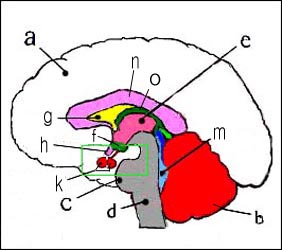
사진 1-1. 뇌하수체와 뇌 측면도.
a-대뇌, b-소뇌, c-뇌교(교뇌), d-연수(숨뇌), f-시상하부, g-간뇌, h-시신경 교차, k-뇌하수체의 전엽과 후엽, m- 제4뇌실, n-뇌량, o- 제3뇌실.
참고 문헌-Grays anatomy
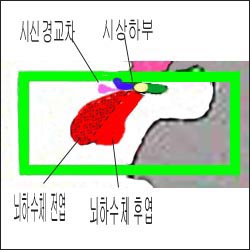
그림 1-2. 뇌하수체와 시상하부.
Copyright ⓒ 2011 John Sangwon Lee, MD., FAAP
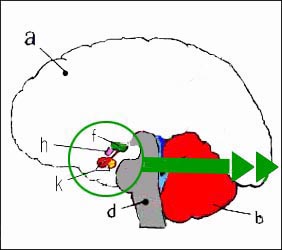
그림 1-3. 뇌하수체와 뇌 측면.
a-대뇌, b-소뇌, d-연수(숨뇌), f-시상하부, h-시신경 교차, k-뇌하수체 전엽과 후엽.
출처-Grays anatomy
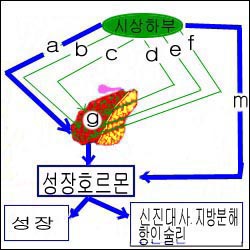
그림 1-4. 뇌하수체와 시상하부.
a-성장 호르몬 자극호르몬,
b-부신피질 자극호르몬,
c-갑상선 자극호르몬분비,
d-성샘 자극호르몬,
e-황체 자극호르몬 유리호르몬,
f-프로랙틴 자극인자와 프로랙틴 분비억제호르몬,
g-뇌하수체 전엽,
m-소마토스타틴(성장호르몬 분비 억제 호르몬).
Copyright ⓒ 2011 John Sangwon Lee, MD., FAAP
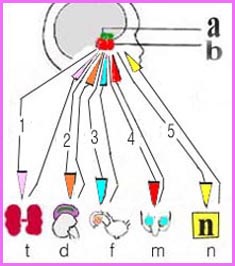
그림 1-6. 음성 피드백 기전(Negative feedback system)에 의해 뇌하수체와 신체 다른 계통에 있는 내분비선들과 상호작용하여 호르몬 분비가 조절된다.
a-시상 하부, b-뇌하수체 전엽, d-부신, f-난소, m-고환, t-갑상선, n-심장·췌장·간장·신장·근육·지방·골격 등 각종계통과 기관,
1-갑상선 자극호르몬,
2-부신피질 자극호르몬(코르티코트로핀),
3-난포 자극호르몬(FSH),
4-난포자극호르몬(FSH),
5-성장 호르몬(소마토트로핀).
Copyrightⓒ 2011 John Sangwon Lee,MD., FAAP
-
뇌하체 후엽에서 항이뇨호르몬(ADH)과 옥시토신이 분비된다.
-
갑상선에서는 칼시토닌, 타이록신(T4), 트리아이오드타이로닌(T3)이 분비된다.
-
부갑상선에서 부갑상선 호르몬이 분비된다.
-
부신수질에서는 에피네프린과 노르에피네프린이 분비된다.
-
부신피질에서는 알도스테론과 코르티솔이 분비되고
-
췌장에서 글루카곤, 인슐린, 소마토스타틴이 분비된다.
- Figure 1-1. Lateral view of the brain and the pituitary gland.
a-Cerebrum, b-Cerebellum, c-Pons, d-Medulla oblongata, f-Hypothalamus, g-Diencephalon, h-Optic chiasm, k-Anterior and posterior lobes of the pituitary gland, m-Fourth ventricle, n-Corpus callosum, o-Third ventricle.
Reference: Gray’s Anatomy
Figure 1-2. The pituitary gland and the hypothalamus.
Copyright ⓒ 2011 John Sangwon Lee, MD., FAAP
Figure 1-3. Lateral view of the brain and the pituitary gland.
a-Cerebrum, b-Cerebellum, d-Medulla oblongata, f-Hypothalamus, h-Optic chiasm, k-Anterior and posterior lobes of the pituitary gland.
Source: Gray’s Anatomy
Figure 1-4. The pituitary gland and the hypothalamus.
a-Growth hormone-releasing hormone,
b-Adrenocorticotropic hormone (ACTH),
c-Thyroid-stimulating hormone (TSH),
d-Gonadotropins,
e-Luteinizing hormone-releasing hormone (LHRH),
f-Prolactin-releasing factor and prolactin-inhibiting hormone,
g-Anterior lobe of the pituitary gland,
m-Somatostatin (growth hormone-inhibiting hormone).
Copyright ⓒ 2011 John Sangwon Lee, MD., FAAP
Figure 1-6. Hormone secretion is regulated through interactions between the pituitary gland and endocrine glands in other body systems via a negative feedback system. a-Hypothalamus, b-Anterior pituitary gland, d-Adrenal gland, f-Ovary, m-Testis, t-Thyroid gland, n-Various systems and organs, including the heart, pancreas, liver, kidneys, muscles, adipose tissue, and skeleton,
1-Thyroid-stimulating hormone (TSH),
2-Adrenocorticotropic hormone (corticotropin),
3-Follicle-stimulating hormone (FSH),
4-Follicle-stimulating hormone (FSH),
5-Growth hormone (somatotropin).
Copyrightⓒ 2011 John Sangwon Lee, MD, FAAP
Antidiuretic hormone (ADH) and oxytocin are secreted by the posterior pituitary gland.
The thyroid gland secretes calcitonin, thyroxine (T4), and triiodothyronine (T3).
The parathyroid glands secrete parathyroid hormone.
The adrenal medulla secretes epinephrine and norepinephrine.
The adrenal cortex secretes aldosterone and cortisol.
The pancreas secretes glucagon, insulin, and somatostatin. -
고환에서 테스토스테론,
-
난소에서 에스트로겐과 프로게스테론이 분비된다.
-
뇌하수체와 신체의 각 계통에 있는 모든 표적 내분비선과 상호관계는 그림 1-6에서 볼 수 있다.
-
수요공급 법칙과 음성 피드백 기전에 따라 뇌하수체에서 뇌하수체 자극 호르몬이 분비된다.
-
뇌하수체 내분비선 자극 호르몬의 영향으로 신체의 각 계통에 있는 각 표적 내분비선에서 특정 호르몬이 분비된다(빨간 선).
-
각 표적 내분비선 호르몬 분비 양의 증감에 따라, 즉 음성 피드백 기전에 따라 뇌하수체 자극 호르몬 분비 양의 증감이 생긴다(파란 선).
-
이와 같이 뇌하수체 자극 호르몬 분비의 양과 신체의 다른 표적 내분비선 호르몬 분비의 양은 체내 호르몬 수요-공급 법칙과 음성 피드백 기전에 따라 변화되고 조절된다.
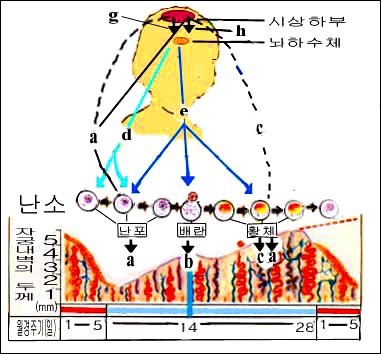
그림 1-7. 월경주기에 따른 여성 호르몬 분비 기전.
a-에스트로겐,
c-프로제스테론,
d-난포자극 호르몬,
e-황체형성 호르몬,
g-난포자극 호르몬 분비인자,
h-황체형성 호르몬 분비인자.
Copyrightⓒ 2011 John Sangwon Lee, MD., FAAP
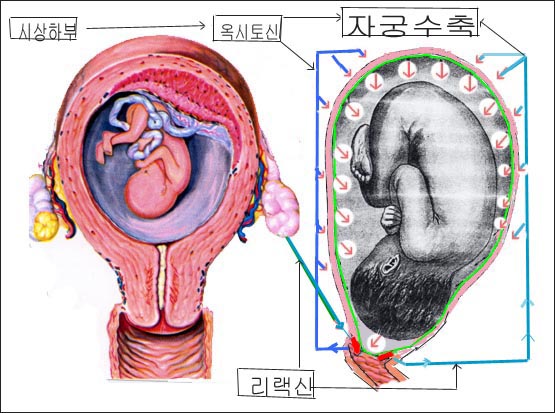
그림 1-8. 분만이 시작되면
-
자궁경관이 벌어지고
-
리랙신 호르몬이 난소의 황체에서 분비되고
-
그로 인해 자궁경관이 점점 더 벌어진다.
-
시상하부에서 뇌하수체 후엽까지 연결시키는 특수 축삭이 있다.
-
시상하부에서 분비되는 신경 물질이 특수 축삭을 따라 뇌하수체 후엽으로 분비된다.
-
뇌하수체 후엽에서 옥시토신과 항이뇨 호르몬이 분비되고
-
옥시토신 작용으로 인해 자궁벽이 수축된다. (→ : 자궁 수축)
-
Copyright ⓒ 2011 John Sangwon Lee., MD., FAAP
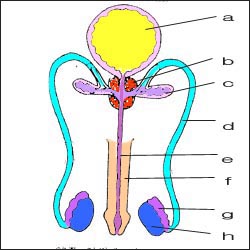
그림 1-9. 고환과 남성의 내부 생식기와 외부 생식기
a-방광, b-전립선, c-정낭, d-정관, e-요도, f-자지(음경), g-부고환, h-고환.
Copyrightⓒ 2011 John Sangwon Lee, MD., FAAP
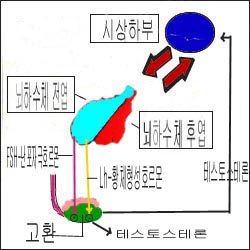
그림 1-10. 고환, 남성 호르몬-테스토스테론, 뇌하수체 호르몬.
Copyright ⓒ 2011 John Sangwon Lee, MD., FAAP
Figure 1-7. Mechanism of female hormone secretion throughout the menstrual cycle.
a-Estrogen,
c-Progesterone,
d-Follicle-stimulating hormone (FSH),
e-Luteinizing hormone (LH),
g-Follicle-stimulating hormone-releasing factor,
h-Luteinizing hormone-releasing factor.
Copyrightⓒ 2011 John Sangwon Lee, MD., FAAP
Figure 1-8. At the onset of labor:
The cervix begins to dilate.
The hormone relaxin is secreted by the corpus luteum in the ovary,
which causes the cervix to dilate further.
Specialized axons connect the hypothalamus to the posterior pituitary gland.
Neurosubstances secreted by the hypothalamus travel along these specialized axons to the posterior pituitary.
The posterior pituitary releases oxytocin and antidiuretic hormone (ADH).
Oxytocin triggers the contraction of the uterine wall. (→ : Uterine contraction)
Copyright ⓒ 2011 John Sangwon Lee, MD., FAAP
Figure 1-9. The testes and the male internal and external reproductive organs.
a-Bladder, b-Prostate gland, c-Seminal vesicle, d-Vas deferens, e-Urethra, f-Penis, g-Epididymis, h-Testis.
Copyrightⓒ 2011 John Sangwon Lee, MD., FAAP
Figure 1-10. The testes, the male hormone (testosterone), and pituitary hormones.
Copyright ⓒ 2011 John Sangwon Lee, MD., FAAP
-
뇌하수체에서
-
성장 호르몬,
-
갑상선 자극 호르몬,
-
부신피질 자극 호르몬,
-
난포 자극 호르몬(FSH),
-
황체형성 호르몬(LH),
-
프로락틴 호르몬이 분비되고 그로 인해 신체의 기본 생명 유지가 계속되고 소아의 성장 발육이 계속된다.
-
- 인체 내분비선, 태반 호르몬, 임신 중, 분만 중, 분만 후 유방 발육과 모유 분비 기전.
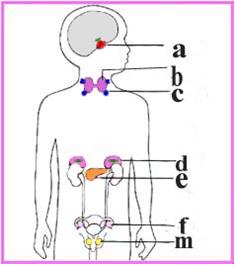
그림 1-34. 갑상선과 그 외 내분비선 해부도.
a-뇌하수체,
b- 갑상선,
c-부갑상선,
d-췌장,
e-부신,
f-난소,
m-고환 등은 내분비선들이다.
Copyright ⓒ 2011 John Sangwon Lee, MD., FAAP
출처 및 참조 문헌
-
소아가정간호백과–부모도 반의사가 되어야 한다, 이상원
-
Nelson Textbook of Pediatrics 14th ed. Beherman,
-
The Johns Hopkins Hospital, The Harriet Lane Handbook, 18th edition
-
Red book 29th edition 2012
-
Nelson Textbook of Pediatrics, 19th Edition
-
Infectious disease of children, Saul Krugman, Samuel L Katz, Ann A. Gershon, Catherine Wilfert
-
The Harriet Lane Handbook, 19th Edition
-
제14권 소아청소년 내분비․유전․염색체․대사․휘귀병 참조문헌 및 출처
-
Sources and references on Growth, Development, Cares, and Diseases of Newborn Infants
-
Emergency Medical Service for Children, By Ross Lab. May 1989. p.10
-
Emergency care, Harvey Grant, and Robert Murray
-
Emergency Care Transportation of Sick and Injured American Academy of Orthopaedic Surgeons
-
Emergency Pediatrics: A Guide to Ambulatory Care, Roger M. Barkin, Peter Rosen
-
Endocrine and Genetic Diseases of Childhood and Adolescence, Lytt I Gardner, M.D., W.B. Saunders
-
Recognizable Patterns of Human Malformation, Smith
-
Diagnosis in Color Pediatrics, Taylor Raffles
-
Atlas of PEDIATRIC PHYSICAL DIAGNOSIS, Frank A. Oski
-
Growth and Development of Children, George H. Lowrey, 8th ed
-
소아과학 대한교과서
-
의학 용어사전 대한 의사 협회
-
그 외
Copyright ⓒ 2014 John Sangwon Lee, MD., FAAP
“부모도 반의사가 되어야 한다” – 내용은 여러분들의 의사로부터 얻은 정보와 진료를 대신할 수 없습니다.
“The information contained in this publication should not be used as a substitute for the medical care and advice of your doctor. There may be variations in treatment that your doctor may recommend based on individual facts and circumstances.
“Parental education is the best medicine.
Copyright drleepediatrics.com 2/17/2026
The pituitary gland secretes growth hormone, thyroid-stimulating hormone (TSH), adrenocorticotropic hormone (ACTH), follicle-stimulating hormone (FSH), luteinizing hormone (LH), and prolactin. These hormones are essential for maintaining the body’s basic vital functions and supporting the growth and development of children.
This section covers human endocrine glands, placental hormones, and the mechanisms underlying breast development and milk secretion during pregnancy, childbirth, and the postpartum period.
Figure 1-34. Anatomical illustration of the thyroid and other endocrine glands.
a–Pituitary gland,
b–Thyroid gland,
c–Parathyroid gland,
d–Pancreas,
e–Adrenal gland,
f–Ovary,
m–Testis, etc., are all endocrine glands.
Copyright © 2011 John Sangwon Lee, MD, FAAP
Sources and References
*Encyclopedia of Pediatric and Family Nursing: Parents Should Also Be Half-Doctors*, by Sangwon Lee
*Nelson Textbook of Pediatrics*, 14th ed., Behrman et al.
*The Harriet Lane Handbook*, The Johns Hopkins Hospital, 18th ed.
*Red Book*, 29th ed. (2012)
*Nelson Textbook of Pediatrics*, 19th ed.
*Infectious Diseases of Children*, by Saul Krugman, Samuel L. Katz, Ann A. Gershon, and Catherine Wilfert
*The Harriet Lane Handbook*, 19th ed.
References and sources for Volume 14: Pediatric and Adolescent Endocrinology, Genetics, Chromosomal Disorders, Metabolic Diseases, and Rare Diseases
Sources and references on the growth, development, care, and diseases of newborn infants
*Emergency Medical Services for Children*, by Ross Laboratories May 1989. p.10
Emergency Care, by Harvey Grant and Robert Murray
Emergency Care and Transportation of the Sick and Injured, American Academy of Orthopaedic Surgeons
Emergency Pediatrics: A Guide to Ambulatory Care, by Roger M. Barkin and Peter Rosen
Endocrine and Genetic Diseases of Childhood and Adolescence, by Lytt I. Gardner, M.D., W.B. Saunders
Recognizable Patterns of Human Malformation, by Smith
Diagnosis in Color: Pediatrics, by Taylor Raffles
Atlas of Pediatric Physical Diagnosis, by Frank A. Oski
Growth and Development of Children, by George H. Lowrey, 8th ed.
Textbook of Pediatrics (Korean)
Medical Terminology Dictionary, Korean Medical Association
Others
Copyright © 2014 John Sangwon Lee, M.D., FAAP
“Parents should also become ‘part-time’ doctors” — The content provided here cannot replace the information and medical care you receive from your own physician.
“The information contained in this publication should not be used as a substitute for the medical care and advice of your doctor. There may be variations in treatment that your doctor may recommend based on individual facts and circumstances.”
“Parental education is the best medicine.”
Copyright drleepediatrics.com 2/17/2026