갓 태어난 내 아기에게 줄 수 있는 가장 좋은 선물은 사랑으로 주는 모유이다.
The best gift for my newborn infant is the mom’s breast milk with love

사진 4-1. 모유수유와 사랑
Used with permission from Mead Johnson Nuritionals, USA와 소아가정간호백과-부모도 반의가 되어야 한다.
모유는 엄마 아빠의 순수한 사랑이다.
|
-
모유수유로 내 아기를 키우는 것은 엄마의 젖을 먹는 아기에게는 물론이고 젖먹이는 엄마와 아기의 아빠의 정신 육체 건강에 좋다.
-
또 경제적이다.
-
나아가서는 그 나라의 전 국민 육체 건강 증진에도 한없이 좋고 그 나라의 전 국민의 정신건강에도 좋다.
-
사랑하는 내 아기에게 내 젖을 먹여 키우면 아기의 정신 육체 건강에 좋은 점이 많이 있다는 사실을 잘 알고 있다. 그렇지만 모유를 수유하는 방법을 잘 몰라 모유수유를 시작하지 않는 엄마들도 많다.
-
또 인공영양(Artificial formula/Infant formula, 참고로 많은 사람들은 인공영양을 “분유”라고 부른다.)으로 아기를 키우는 것보다 모유수유로 아기를 키우는 것이 아기뿐만 아니라 엄마, 아빠에게도 많은 이점이 있다는 사실을 잘 몰라 아예 모유수유를 시작할 생각도 않는 엄마 아빠들도 있다.
-
모유의 성분과 인공영양의 성분이 거의 비슷하다고 생각도 하고, 또는 똑같다고 생각하는 엄마 아빠들도 많다. 또 인공영양의 성분이 모유의 성분과 같이 아기의 성장 발육 건강에 최고로 좋은 줄로 잘못 알고 있는 엄마 아빠들도 많다.
-
임신 중 모유를 먹여 아기를 키울 것인지 또는 인공영양을 먹여 아기를 키울 것인지 둘 중 한 가지를 선택할 때 엄마 아빠가 내 아기에게 먹이고 싶은 대로 그냥 선택하면 되는 것으로 생각하는 엄마 아빠들도 많이 있다.
-
이런저런 이유로 모유수유로 아기를 키우는 대신 인공영양으로 아기를 키우는 엄마 아빠들이 많이 있게 된다. (참고로 일부 엄마들은 “인공영양”을 “분유”라고 부르기도 한다).
-
알고 보면, 모유수유로 아기를 키우는 것이 인공영양으로 아기를 키우는 것보다 훨씬 더 편리하고 쉽고, 모유를 먹고 자란 아기들은 인공영양을 먹고 자란 아기들보다 훨씬 더 건강하다.
-
모유는 아기들에게 완전한 영양식품이고 영양가가 담뿍 든 자연식품이다. 거기다가 모유는 엄마 아빠의 사랑이다.
-
성장하는 아기들에게 필요로 하는 영양분과 에너지가 모유 속에 다 들어 있다. 모유수유는 젖 먹는 아기에게 모든 병이 생기지 않게 예방하는 효과도 탁월하다. 그래서 모유는 아기의 질병을 예방할 수 있는 예방약이고 백신이고 보약이다.
-
모유수유를 하는 동안 아기는 엄마로부터 받은 눈길 접촉사랑, 신체적 접촉사랑, 집중적 관심적 사랑과 보살핌을 흠뻑 받는다. 모유를 먹는 아기들은 정신적으로 정서적으로 더 만족하고 신체적으로 더 건강하게 자란다. 커서도 건전한 자부심을 더 많이 갖고 산다.
-
모유수유하는 엄마 아빠 역시 엄마의 젖을 자기의 아기에게 직접 먹여 소중한 자녀를 건강하게 키울 수 있다고 생각 할 때 엄마는 자녀 양육에서 더 떳떳하고 자신감과 만족감을 가질 수 있다. 그래서 엄마와 아기에게 사랑 반딩(Love Bonding)이 굳건히 형성된다.
-
안타깝게도 각종 매스컴들은 모유수유로 아기들을 키우는 것이 여러 모로 좋다고 강조하는 데는 인색하다. 또 거기다가 여성들의 유방은 모유수유를 하기 위한 인체의 한 기관인데도 성적인 면이나 육체적 면에 더 관련시키고 있다.
- The best gift you can give your newborn is breast milk, offered with love.Photo 4-1. Breastfeeding and Love
(Used with permission from Mead Johnson Nutritionals, USA, and *Encyclopedia of Pediatric and Family Nursing: Parents Must Also Become Experts*.)
Breast milk is the pure love of a mother and father.
It is the embodiment of their love—a complete source of nutrition for a newborn.
While providing a baby with the highly nutritious gift of breast milk is vital, the physical skin-to-skin contact that occurs during breastfeeding—a form of love expressed through touch—is of immeasurable importance to both the baby and the mother.
Through this, a bond of love between mother and child is forged, becoming so strong that nothing can ever break it.
Who in this world could possibly sever such a bond?
Furthermore, breastfeeding offers the mother ample opportunity to share the love conveyed through eye contact.
It also allows for the expression of deep, focused, and attentive love.
Oxytocin is a hormone secreted by the posterior lobe of the pituitary gland in the brain.
It triggers uterine contractions during childbirth and promotes postpartum recovery.
It also causes the mammary glands and milk ducts in a nursing mother’s breasts to contract, facilitating the flow of milk toward the nipple openings. Oxytocin is a “love hormone” that enables a nursing mother to hold her baby close and shower the child with affection. It is also referred to as a “love hormone,” “love drug,” “cuddle chemical,” or a “bonding hormone.” For mothers who breastfeed, this hormone is secreted in appropriate amounts.Raising a baby through breastfeeding is beneficial not only for the infant—who receives the mother’s milk—but also for the mental and physical well-being of both the mother and the father. It is also an economical choice. Furthermore, it contributes significantly to the physical and mental health of the entire population of a nation. While many mothers are well aware that breastfeeding their beloved baby offers numerous mental and physical health benefits, some do not begin the process simply because they do not know how to go about it. Others may not even consider breastfeeding because they are unaware that it provides substantial advantages—not just for the baby, but for the mother and father as well—compared to using infant formula. Many parents mistakenly believe that the composition of infant formula is similar, or even identical, to that of breast milk. Some even incorrectly assume that infant formula is just as optimal as breast milk for a baby’s growth, development, and overall health. Many parents-to-be assume that when deciding how to feed their baby—whether through breastfeeding or formula feeding—they can simply choose whichever method they prefer.
For various reasons, many parents ultimately opt for formula feeding instead of breastfeeding. (Note that some parents refer to “formula feeding” simply as “using baby formula.”)
In reality, breastfeeding is far more convenient and easier than formula feeding, and babies who are breastfed tend to be significantly healthier than those who are fed formula.
Breast milk is a complete, nutrient-dense, natural food for infants. Beyond that, it embodies the love of the parents.
Breast milk contains all the nutrients and energy a growing baby needs. It is also exceptionally effective at preventing illness in infants; in this sense, breast milk acts as a preventative medicine, a vaccine, and a health tonic.
During breastfeeding, a baby receives an abundance of love and care—expressed through eye contact, physical touch, and focused, undivided attention. Breastfed babies tend to be more mentally and emotionally fulfilled, as well as physically healthier. As they grow older, they are also more likely to possess a healthy sense of self-esteem. When mothers—and fathers—recognize that breastfeeding allows them to nourish their precious child directly, it fosters a greater sense of pride, confidence, and fulfillment in the mother’s role as a parent. This process helps to forge a strong, loving bond between mother and baby.
Unfortunately, the media is often reluctant to emphasize the many benefits of raising babies through breastfeeding. Furthermore, although a woman’s breasts are, in fact, biological organs designed for breastfeeding, they are more frequently associated with sexual or purely physical attributes. -
여기저기서 받은 잘못된 메시지로 많은 엄마아빠들은 모유수유로 아기들을 키우는 대신 인공영양으로 키우고 있는 실정이다. 불행한 일이다. 그러나 요즘 많은 엄마아빠들이 모유수유로 아기를 키우는 것이 아기들에게도 많은 이점이 있다는 것을 더 확실히 인식해 모유수유 하는 엄마아빠들이 점점 늘어가는 추세인 것은 극히 다행이다.
-
몇 일전 세계 모유수유 장려 행사를 한국 보건복지부, 한국 소아청소년과학회, 한국 산부인과학회 주최로 서울서 열었다. 약300명의 여성들이 참석한 것을 보고 퍽 놀랬다. 모유수유에 정부, 소아청소년과, 산과학회가 동참하는데 놀랬다. 다행스러웠다.
-
자궁 속에서 자라고 있는 아기에게 태어난 아기에게 엄마, 아빠가 엄마의 젖을 먹겠느냐 그렇지 않으면 인공영양을 먹겠느냐 직접 물어보고 무엇을 머길 것인가 결정하는 것이 어떨까?
-
이런 선택권을 산모에게 주고 싶다. 사랑하는 아기에게 소젖을 먹이시곘습니까 그렇지 않으면 엄마의 젖을 먹이시겠습니까.
미국 모유수유 현황 |
-
미국 한 연구에 의하면, 분만 후 32%의 산모들은 모유수유를 시작하지도 않는다.
-
약 4%의 산모들은 모유수유를 시작 한 후 1주도 못가서 모유수유를 더 이상 하지 않고,
-
13%의 산모들은 분만 후 1~4주 동안만 모유수유를 한다.
-
그리고 51%는 분만 후 4주 이상 모유수유를 한다고 한다.
-
미국 모유수유 율이 1995년에 59%이었고 2004년에는 74%이었다.
-
생후 6개월까지 미국 모유수유 율은 1995년에 22%이었고 2004년에는 42%이었다.
-
2004년도 미국의 다른 연구에 의하면 주로 모유수유만 한 모유수유 율은 분만 후 7일까지 51%이었고 분만 후 6개월까지 모유수유 율은 불과 14%이었다. (소스와 참고서; Arch Pediatr Adolesc Med. 2008.)
모유와 모유수유의 좋은 점 |
Advantages of breast milk and breastfeeding
모유와 모유수유의 좋은 점에 관해서 이미 설명 했다. 모유수유로 아기를 양육할 때 모유수유의 좋은 점을 구체적으로 더 알아보자.
-
모유의 온도는 언제든지 어디서든지 아기에게 바로 먹을 수 있게 적절하다.
-
인공영양으로 아기를 양육할 때는 인공영양을 먹이기 전 우유병, 우유병 꼭지, 우유병 마게 등을 깨끗이 씻어야 한다.
-
때로는 그 우유병, 우유병 꼭지 등을 끓는 물로 살균 처리해야 한다. 인공영양의 온도를 먹기 좋게 조절해야 한다. 모유수유를 할 때는 우유병 등을 씻고 소독할 필요가 없다.
-
인공영양을 먹이기 위해 준비하는 바로 전까지 박테리아나 바이러스 등 병원체가 인공영양에 오염될 수 있다.
-
모유를 수유 하는 중, 수유모 체외 박테리아, 바이러스, 그 외 다른 종류의 병원체가 빨아 먹는 모유 속으로 쉽게 오염되지 않다. ( 모유수유 금기 참조)
-
모유를 먹고 자라는 아기들은 인공영양을 먹고 자라는 아기들에 비해 박테리아, 바이러스, 그 외 다른 병원체의 감염으로 감염병에 훨씬 덜 걸릴 수 있다.
-
또 감염병, 소화 장애, 알레르기 위장염, 그 외 다른 여러 종류의 병에 덜 걸린다.
-
양육비, 의료비가 절약되고 병원에 갈 일도 적게 생기고 병원 입원치료를 받을 가능성도 적다.
-
모유를 먹고 자라는 아기들은 바이러스성 위장염이나, 호흡기계 질환, 중이염, 설사, 박테리아 뇌막염, 요로 감염, 그 외 다른 종류의 병원체 감염에 덜 걸린다.
-
모유는 인공영양보다 소화가 더 잘 된다.
-
모유는 각종 질환에 덜 걸리게 해서 아기를 보호한다.
-
엄마의 젖을 먹고 자라는 아기들은 인공영양을 먹고 자라는 아기들에 비해 알레르기성 비염, 알레르기성 소화기 질환, 기관지 천식, 아토피 피부염 등 알레르기 질환에 훨씬 덜 걸린다.
-
모유를 먹는 아기들에게는 인공영양을 먹는 아기들에 비해서 영아산통, 변비가 덜 생긴다.
-
엄마의 젖을 먹고 자라는 아기들에게도 알레르기 질환이 생길 수 있지만 우유 단백이나 콩 단백의 성분이 든 인공영양을 먹고 자라는 아기들에게는 알레르기 질환이 훨씬 더 생긴다.
-
박테리아, 바이러스, 그 외 다른 종류의 병원체의 침입을 받았을 때 그 병원체를 죽일 수 있는 IgA 등 면역글로빈, 백혈구, 거대세포, 보체(Complements), 락토페린(Lactoferrin), 라이소자임(Lysozyme) 등 항 병원체 인자와 그 외 다른 생화학 물질이 모유 속에 들어 있으나 인공영양 속에는 들어 있지 않다. 그래서 젖 먹는 아기들은 중이염, 위장염, 패혈증, 폐렴, 요로 감염 등 여러 종류의 감염병에 덜 걸린다.
-
최근 인공영양 속에 뇌와 눈의 기능을 증진시키는데 필수적으로 필요한 DHA와 ARA 성분을 첨가 조제 하지만 모유 속에는 자연 DHA와 ARA 성분이 충분히 들어 있다.
-
그 외 신체의 성장 발육을 촉진시킬 수 있는 생화학적 물질도 모유 속에 들어 있다.
-
암을 예방할 수 있는 생화학적 물질이 모유 속에 들어 있다.
-
성장 발육을 촉진시키는 호르몬이 들어 있다.
-
인공영양을 먹고 자란 아이들의 지능 지수는 모유를 먹고 자란 아이들의 지능 지수보다 더 낮고 학습장애가 더 잘 생길 수 있다.
-
임신 중 아무리 잘 태교해도 모유 대신 인공영양을 먹고 자라는 아이들의 IQ가 더 낮다.
-
인공영양을 먹고 자란 아이들은 과식하는 경향이 더 많고 더 쉽게 비만해진다. 소아 비만이 생기고 결국 성인 비만으로 이어지기 더 쉽다.
-
1형 당뇨병이나 2형 당뇨병의 발생률이 모유를 먹고 자란 아이들에게 덜 발생한다.
-
백혈병, 림프종, 호지킨병, 고 콜레스테롤 혈증, 고지질 혈증과 고지질 단백 혈증 등 신진대사 질환 발생률이 모유를 먹고 자란 아이들에게 덜 발생한다.
-
인공영양을 먹고 자란 아이들에게 모유를 먹고 자란 아이들에 비해 충치, 부정교합 등 치아장애 발생률이 더 높고 얼굴 근육 발달 장애 발생률이 더 높다. .
-
비피도박테륨 랰티스(Bifidobacterium lactis) 박테리는 모유를 먹는 아기들의 위장관 속 상존 균 군집의 80~90%를 차지한다.
-
젖 먹는 아기들의 위장관 속 비피도박테륨 박테리아 군집은 위장관 속에 병원성 박테리아가 자라지 못하게 하는 역할을 하고 장관 점막층에서 lgA 항체 생성 증진을 촉진된다.
-
그래서 모유를 먹고 자라는 아기들은 병원성 박테리아 감염으로 박테리아 감염성 위장염에 덜 걸린다.
-
그리고 비피도박테륨 박테리아는 모유를 먹는 아기들의 성장 발육을 촉진시킨다. 이런 이유로 요즘 비피도박테륨(Bifidobacterium lactis)을 인공영양에 첨가해 조제하기도 한다.
-
생후 0~6개월까지 정상적으로 성장 발육하는 데 필요로 하는 단백질, 탄수화물, 지방, 비타민, 수분, 미네랄 등이 균형 잡힌 음식물을 충분히 섭취한 건강한 수유모의 모유 속에는 충분히 들어 있다.
-
인공영양을 먹일 때 엄마가 품에 아기를 폭신 않고 사랑하면서 인공영양을 잘 먹이면 아기는 잘 자랄 수 있지만 엄마가 따뜻한 유방 젖꼭지를 아기의 입안에 물리고 유방을 아기의 살갗에 직접 대고 젖을 먹을 때 느낄 수 있는 신체 접촉 사랑과 비교할 수 없다.
-
엄마가 아기를 품에 안고 젖을 먹일 때 아기는 엄마의 눈길 접촉사랑, 신체적 접촉사랑, 그리고 집중적 관심적 사랑과 보살핌을 더 많이 받고 있다고 느낀다.
-
엄마의 젖을 아기에게 먹이는 동안 엄마의 신체 내 모성 호르몬(엄마 호르몬)이 분비된다. 이 호르몬은 엄마의 젖을 먹는 아기가 모정을 듬뿍 느낄 수 있게 촉진 시키고 엄마와 아기의 모자간 사랑 반딩을 더 굳건히 형성되게 하며 아기가 정신적으로 정서적으로 더 안정감을 갖게 하는 역할을 한다. 그 호르몬은 옥시토신(Oxytocin)이다.
-
엄마는 자신의 젖을 아기에게 직접 먹여 내 자식을 더 건강하게 더 똑똑하게 잘 키울 수 있다는 자신감을 더 많이 가질 수 있다.
-
수유하는 엄마 아빠와 아기 모두는 정신적으로 육체적으로 안정감을 더 갖게 된다. 엄마 아빠와 아기 사이에 부모 자식 간 사랑 반딩(Bonding)이 더욱 굳게 형성된다.
-
모유수유하는 동안 임신 분만으로 생긴 자궁의 변화, 육체적 정신적 변화와 피로 등이 정상적으로 더 빨리 회복될 수 있다.
-
모유수유를 하는 동안 자연적으로 피임될 수 있다.
Due to misinformation received from various sources, many parents end up feeding their babies formula instead of breast milk—a truly unfortunate situation. Fortunately, however, an increasing number of parents are becoming more aware of the significant benefits that breastfeeding offers their infants, and the trend toward breastfeeding is on the rise.
A few days ago, an event promoting breastfeeding was held in Seoul, hosted by the South Korean Ministry of Health and Welfare, the Korean Pediatric Society, and the Korean Society of Obstetrics and Gynecology. I was quite surprised to see about 300 women in attendance. It was also heartening to see the government, along with pediatric and obstetric medical societies, joining forces to support breastfeeding.
Perhaps we should consider this: what if parents were to ask their baby—whether still in the womb or already born—whether they would prefer breast milk or formula, and then base their decision on that?
I would like to offer mothers this choice: would you choose to feed your beloved baby cow’s milk, or would you choose to provide your own breast milk?
Breastfeeding Statistics in the United States
According to a study in the United States, 32% of mothers do not even begin breastfeeding after giving birth.
About 4% of mothers stop breastfeeding within the first week,
while 13% continue for only one to four weeks postpartum.
Meanwhile, 51% of mothers continue to breastfeed for more than four weeks after childbirth. In the United States, the breastfeeding rate was 59% in 1995 and 74% in 2004.
The rate of breastfeeding up to six months of age in the U.S. was 22% in 1995 and 42% in 2004.
According to another U.S. study from 2004, the rate of exclusive breastfeeding was 51% during the first seven days postpartum, while the rate of breastfeeding up to six months postpartum was only 14%. (Source/Reference: Arch Pediatr Adolesc Med. 2008.)
Benefits of Breast Milk and Breastfeeding
The benefits of breast milk and breastfeeding have already been discussed. Let’s take a closer look at the specific advantages of raising a baby through breastfeeding.
Breast milk is always at the perfect temperature for a baby to consume, anytime and anywhere.
When feeding a baby with formula, the bottle, nipple, and cap must be thoroughly cleaned before use.
At times, these items—such as the bottle and nipple—must also be sterilized in boiling water. Additionally, the temperature of the formula must be adjusted to a suitable level for the baby. With breastfeeding, there is no need to wash or sterilize bottles or other equipment.
Formula can become contaminated with pathogens, such as bacteria or viruses, at any point before it is prepared and fed to the baby.
During breastfeeding, it is highly unlikely for bacteria, viruses, or other pathogens present outside the mother’s body to contaminate the breast milk as the baby nurses. (See: Contraindications to Breastfeeding)
Compared to infants fed with formula, those who are breastfed are significantly less likely to contract infectious diseases caused by bacteria, viruses, or other pathogens.
They also experience fewer instances of infectious diseases, digestive disorders, allergic gastroenteritis, and various other illnesses.
Breastfeeding leads to savings on childcare and medical expenses, results in fewer doctor visits, and reduces the likelihood of hospitalizations.
Breastfed infants are less susceptible to viral gastroenteritis, respiratory tract infections, otitis media (middle ear infections), diarrhea, bacterial meningitis, urinary tract infections, and other pathogen-based illnesses.
Breast milk is easier to digest than formula.
Breast milk protects infants by lowering their risk of developing various diseases.
Compared to formula-fed infants, those who are breastfed have a much lower risk of developing allergic conditions, such as allergic rhinitis, allergic gastrointestinal disorders, bronchial asthma, and atopic dermatitis.
Breastfed infants are also less prone to infantile colic and constipation than those fed with formula.
While it is possible for breastfed infants to develop allergic conditions, such issues occur much more frequently in infants fed with formula containing cow’s milk protein or soy protein. Breast milk contains various anti-pathogen factors—such as immunoglobulins (e.g., IgA), white blood cells, macrophages, complement proteins, lactoferrin, and lysozyme—as well as other biochemical substances capable of destroying invading bacteria, viruses, and other types of pathogens. These components are absent in infant formula. Consequently, breastfed infants are less susceptible to various infections, including otitis media (middle ear infections), gastroenteritis, sepsis, pneumonia, and urinary tract infections.
While modern infant formulas are fortified with DHA and ARA—substances essential for enhancing brain and eye function—breast milk naturally contains an adequate supply of these components.
Breast milk also contains biochemical substances that promote physical growth and development.
It includes biochemical agents that may help prevent cancer.
It contains hormones that stimulate growth and development.
Children raised on infant formula tend to have lower IQ scores and a higher risk of developing learning disabilities compared to those who were breastfed.
Regardless of how well a mother manages her prenatal care, children who are fed formula instead of breast milk tend to have lower IQs.
Children raised on formula are more prone to overeating and are more likely to become obese; this often leads to childhood obesity, which can subsequently persist into adulthood.
The incidence of both type 1 and type 2 diabetes is lower among individuals who were breastfed as infants. Children who are breastfed have a lower incidence of conditions such as leukemia, lymphoma, Hodgkin’s disease, and metabolic disorders—including hypercholesterolemia, hyperlipidemia, and hyperlipoproteinemia—compared to those who are not.
Children who are fed with breast-milk substitutes (formula) experience higher rates of dental issues, such as tooth decay and malocclusion, as well as developmental impairments in facial muscles, compared to those who are breastfed.
*Bifidobacterium lactis* bacteria make up 80–90% of the microbial population residing in the gastrointestinal tracts of breastfed infants.
In the gastrointestinal tracts of breastfed infants, *Bifidobacterium* colonies help prevent the growth of pathogenic bacteria and promote the production of IgA antibodies within the mucosal lining of the intestinal tract.
Consequently, breastfed infants are less susceptible to bacterial gastroenteritis caused by pathogenic bacterial infections.
Furthermore, *Bifidobacterium* bacteria promote the growth and development of breastfed infants. For this reason, *Bifidobacterium lactis* is now sometimes added to infant formula.
Breast milk from a healthy, nursing mother contains an adequate and balanced supply of the proteins, carbohydrates, fats, vitamins, water, and minerals necessary for the normal growth and development of an infant from birth to six months of age. While a baby can certainly thrive when fed formula—provided the mother holds the infant close and feeds them with love—this cannot compare to the physical intimacy and affection experienced during breastfeeding, where the baby latches onto the mother’s warm breast and feels the direct, skin-to-skin contact.
When a mother holds her baby to breastfeed, the infant perceives a greater sense of love through eye contact, physical touch, and the mother’s undivided attention and care.
During breastfeeding, the mother’s body releases specific maternal hormones. These hormones help the baby fully sense the mother’s affection, strengthen the emotional bond between mother and child, and foster a greater sense of mental and emotional stability in the infant. One such hormone is oxytocin.
Breastfeeding can also boost a mother’s confidence, giving her the assurance that she is nurturing her child to be healthier and more intelligent.
Breastfeeding provides both the parents and the baby with a greater sense of mental and physical stability, while strengthening the bond between them.
It also facilitates a faster recovery from the physical and mental changes—as well as the fatigue—that occur in the mother’s body following pregnancy and childbirth.
Furthermore, breastfeeding can serve as a natural form of contraception.
-
모유수유는 다이어트 역할을 한다.
-
임신 중 증가됐던 산모의 체중이 임신 전 체중으로 더 빨리 더 쉽게 돌아간다.
-
끝으로 모유는 아기에게 가장 좋고 이상적이고 가장 완전한 자연 음식물이다.
-
모유는 엄마 아빠가 자녀에게 주는 가장 좋은 사랑이다. 모유수유로 아기를 키우면 수유모, 아빠, 젖 먹는 아기는 물론, 그 가정, 그 사회, 그 국가 모두의 정신, 정서, 육체의 건강증진에 좋다.
-
모유수유는 경제적이다.
-
젖 먹는 아이들의 일생의 삶의 가장 좋은 보약이다.
-
최근, 인공영양을 ‘모유와 거의 비슷하게 만들 수 있다는 광고도 있다. 그러나 과학이 아무리 발달해도 인공영양을 모유와 똑같게 만드는 건 불가능하다.
-
인공영양을 조제, 판매 구입 보관하는 과정에 문제가 생길 수 있다. 인공영양을 먹일 준비를 하는 동안 인공영양에 박테리아가 오염될 수 있다. 권장한 양보다 물의 양을 더 적게 더 많게 넣을 수 있다. 부적절한 인공영양 성분으로 만들어 먹일 수 있다.
-
물론 모유수유를 할 때 수유모 체 내외에 있는 박테리아 등 병원체에 오염될 가능성은 있지만 특별한 경우를 제외하고, 모유수유를 하는 중 엄마로부터 병원체에 감염될 가능성은 아주 낮다.
-
인공영양을 먹이는 경우와 모유수유를 할 때 엄마와 아기가 서로 주고받는 특별한 느낌은 아주 다르다. 엄마의 따뜻한 품에 안기어 따뜻한 젖꼭지를 빨 때 느낌과 우유병 꼭지를 빨 때 느낌은 천지 차이일 것이다..
-
불행하게도 오늘 날 많은 산모들이 분만 후 분만 회복을 하지 못하고, 산후 조리도 제대로 하지 못한 채 승용차를 몰고 병원 산실에서 퇴원해 집으로 간다. 아기에게 인공영양을 먹이는 산모들은 인공영양과 우유병 꼭지 등을 구입하기 위해 쇼핑몰 여기저기로 간다.
-
요즘 산모들은 경제적 문제, 가정적 문제 등 여러 가지 문제로, 분만 후 육체적으로 정신적으로 충분히 쉬지 못하고 전업 직장으로 뒤돌아 간다. 사정이 이렇다 보니 모유수유의 장점을 잘 알면서도 부득이 인공영양으로 사랑하는 아기들을 양육하는 실정이 많다.
-
성장하는 어린 아이들뿐만 아니라 부모들 특히 젖 먹이는 엄마들 그리고 세계 각 국가들이 요즘 안고 있는 불행한 자녀양육 실태이다.
-
모유수유로 아기를 양육하는 것이 가장 이상적이라는 건 의심할 여지가 없다. 모유가 최고의 자연 영양식이라는 것도 더 이상 논할 필요가 없다.
-
최근 미 소아청소년과학회, 미 연방 정부, 각종 모유수유 장려 단체는 모유수유 증진 정책에 동참하고 있다.
-
특히 의과 대학 및 모자보건부 등 소아 건강 증진에 관련되어 있는 비영리 단체나 소아건강 문제를 다루는 소아청소년과 전문의들 및 간호사들은 모유수유 증진 정책에 적극적으로 참여해야 한다고 주장한다.
-
분만하기 전 장차 태어날 아기의 단골 소아청소년과 의사가 될 의사는 예비 엄마들에게 모유수유의 이점에 관해 설명하고 아기가 태어나면 인공영양을 먹이겠느냐 또는 모유를 먹이겠느냐 선택권을 주지 말고 갓 태어난 모든 아기에게 모유를 먹이도록 모두가 장려하고 있다.
-
끝으로, 갓 태어난 내 아기에게 엄마아빠가 줄 수 있는 가장 좋은 선물이 무엇이냐고 나에게 묻는다면 나는 두말할 것 없이 ‘모유수유’라고 답할 것이다.
-
물론 모유와 사랑을 함께!
다음은“모유수유, 유방 구조, 모유수유 호르몬 프로랙틴”에 관한 백문 백답입니다. |
Q.&A. 모유수유, 유방 구조, 모유수유 호르몬 프로랙틴에 관한 백문 백답
Q. 유방이란?
A.젖샘(Mammry gland/breast), 즉 유방은 모유를 생성하는 외분선이다. 여성 생식기계의 일부이다. 유방은 앞가슴의 피하조직, 2~6번째 늑골의 사이, 대흉근육, 흉골과 겨드랑이 사이에 위치하고 있다. 유방의 중앙 부위에 젖꼭지가 있다. 젖꼭지를 유두라고 한다. 젖꼭지는 양쪽 유방에 하나씩 있다. 그 유두의 뿌리를 둘러싼 피부부분을 유두륜, 유륜, 젖꼭지판, 또한 젖무리라고 한다. 유륜에는 몽고메리선이 있다. 여기서 피지가 분비된다. (그림 22-41 참조)
Q. 유방의 내부의 구조는?
A. 한 개의 유방 속에는 15~20개 젖샘엽이 있다. 각 젖샘엽에는 유선(포상샘/ 포상선/젖샘)이 많이 있다.
그 포상샘은 포상샘 분비관에 연결되어 있다. 그 포상샘 분비관은 팽대부(유동)로 연결되어 있다. 그 팽대부(유동)는 다시 유관(젖샘관)으로 연결되어 있다. 그 유관은 유두의 젖 구멍으로 연결되어 있다. 유두의 젖 구멍에서 젖이 나온다. (그림 유방 참조)
Q. 유방에서 젖이 만들어지는 경로는?
A. 아기가 젖을 먹을 때 꼭지를 빨 으면서 유륜을 자극하면→ 신경 임펄스가 뇌 시상하부로 전달되고→ 시상하부에서 뇌하수체 후엽으로 신호를 보내어 옥시토신(피토신)분비되고→ 옥시토신은 포상샘을 둘러싸고 있는 근상피세포를 자극하고→ 포상샘(유선)에서 젖(모유)이 분출되고→ 포상샘 분비관→ 팽대부→ 유관(젖샘 관)→ 유두→ 유두 젖구멍을 통과해 젖이 분비된다. 결합조직과 지방조직이 각 젖샘 엽 사이에 있다.
Q. 유방은 어떻게 발육되나?
A.사춘기가 되기 전 까지 남,여아의 유방의 구조는 거의 같다.
사춘기가 시작되면 여성의 난소의 황체에서 분비되는 에스트로겐과 프로게스테론이라는 여성호르
몬에 의해서 유선(젖샘)과 포상샘 분비관(젖분비관) 등이 발육되고 커진다. 그리고 지방조직이 유방 속에 축적된다. 그래서 사춘기 여아들의 유방이 예쁘게 커진다.

사진 4-2.모유수유로 아기를 양육하면 아기에게 이롭고 좋은 점이 참 많다. 모유수유를 하는 동안 엄마의 살갗과 아기의 살갗이 서로 접촉될 때 생기는 신체적 접촉사랑, 거기다가 엄마가 주는 집중적 관심적 사랑 및 보살핌을 받을 수 있는 것은 또한 아기에게도 이롭고 엄마에게도 이롭다. 이런 사실이 있다는 것을 알게 모르게 그냥 지나가고 있다. 젖 먹는 아기는 엄마의 눈길접촉 사랑을 받을 수 있고 엄마 역시 아기로부터 눈길접촉 사랑을 받을 수 있다. 이런 사랑은 모유수유를 하는 중 젖을 먹는 아기와 수유모에게만 생긴다. Copyright ⓒ 2013 John Sangwon Lee, MD., FAAP

사진 4-3.젖 먹는 아기의 눈길을 보라! 엄마의 눈길과 아기의 눈길 접촉사랑을! 바로 이런 눈길 접촉사랑을 통해 모자간의 사랑의 반딩(Bonding)이 굳건히 형성된다. 이런 사랑의 반딩(Bonding)은 모유수유를 할 때 더 굳건히 형성된다. Copyright ⓒ 2011 John Sangwon Lee, MD., FAAP

사진 4-4.젖 먹는 아기의 눈길을 보라! 엄마의 눈길과 아기의 눈길 접촉사랑을! 바로 이런 눈길 접촉사랑을 통해 모자간의 사랑의 반딩(Bonding)이 더 굳건히 형성된다. Copyright ⓒ 2011 John Sangwon Lee, MD., FAAP

사진 4-5. 젖 먹는 아기의 신체적 접촉 사랑을 보라! 엄마의 신체와 아기 간 신체적 접촉사랑을! 바로 이런 신체적 접촉사랑을 통해 모자간의 사랑 반딩(Bonding)이 더 굳건히 형성된다.
Copyright ⓒ 2011 John Sangwon Lee, MD., FAAP

사진 4-6. 젖 먹는 아기의 신체적 접촉을 보라! 엄마의 신체와 아기의 신체적 접촉사랑을! 바로 이런 신체적 접촉사랑을 통해 모아간의 사랑 반딩(Bonding)이 더 굳건히 형성된다. Copyright ⓒ 2011 John Sangwon Lee, MD ., FAAP

사진 4-7.인공영양을 먹이기 위해 필요로 하는 것들이 더 많이 있다. Copyright ⓒ 2011 John Sangwon Lee, MD., FAAP

그림 4-1. 분만 후 모유수유를 하지 않는 산모의 자궁은 피토신 호르몬의 영향을 적게 받아 서서히 수축되고 서서히 회복된다. Copyright ⓒ 2011 John Sangwon Lee, MD., FAAP

그림 4-2. 분만 후 모유수유를 하는 산모의 자궁은 피토신 호르몬의 영향을 받아 더 빨리 수축되고 회복된다. Copyright ⓒ 2011 John Sangwon Lee, MD., FAAP

사진 4-8. 유두륜(유륜, 젖꼭지판)에 두드러지게 나온 여러 개의 작은 결절들이 있다. 그 결절들을 몽고메리 결절이라고 한다. 몽고메리 결절 속에 몽고메리 분비선이 있다. 거기에서 크림과 같은 윤활성 피지가 분비된다. Copyright ⓒ 2011 John Sangwon Lee, MD., FAAP

사진 4-9. 모유는 데우지 않아도 언제든지 먹을 수 있게 온도가 적절하다. 사진에서 유륜에 나있는 몽고메리 돌기 끝부분이 선명하게 보인다. Copyright ⓒ 2011 John Sangwon Lee, MD., FAAP
Q. 임신하면 유방에도 변화가 온다고 하던데?
Furthermore, breastfeeding can serve as a natural form of contraception.
Breastfeeding also acts as a weight-management tool, helping mothers return to their pre-pregnancy weight more quickly and easily.
Ultimately, breast milk is the best, most ideal, and most complete natural food for an infant.
It is the greatest expression of love that parents can offer their child. Breastfeeding promotes the mental, emotional, and physical well-being of the mother, the father, the infant, and by extension, the family, society, and the nation as a whole.
Breastfeeding is also economical.
It serves as the finest lifelong health tonic for a child.
While some advertisements claim that infant formula can be made to be “nearly identical” to breast milk, no matter how advanced science becomes, it is impossible to create an artificial substitute that is truly the same as breast milk.
Issues can arise during the preparation, sale, purchase, or storage of infant formula. Formula can become contaminated with bacteria during preparation; the ratio of water used may be incorrect (too little or too much); or the formula itself may contain improper ingredients.
Although there is a theoretical possibility of exposure to pathogens—such as bacteria present on or within the mother’s body—during breastfeeding, the actual risk of a mother transmitting an infection to her baby is extremely low in almost all circumstances.
Furthermore, the unique emotional connection shared between a mother and her baby differs significantly depending on whether the infant is breastfed or fed with formula. There is a world of difference between the sensation of being held in a mother’s warm embrace while nursing at her breast and the experience of sucking on an artificial bottle teat.
Unfortunately, many mothers today are unable to fully recover from childbirth or receive proper postpartum care before driving themselves home from the hospital. Those who rely on formula must go out to various shops to purchase artificial infant formula, bottles, and teats.
Due to various factors—such as financial pressures or family circumstances—many mothers today are unable to get the physical and mental rest they need after giving birth, often returning directly to their full-time jobs. Consequently, even when mothers are well aware of the benefits of breastfeeding, they are frequently compelled by necessity to raise their beloved children using formula.
This is an unfortunate reality of child-rearing that affects not only growing children and their parents—especially nursing mothers—but also nations across the globe.
There is no doubt that breastfeeding is the most ideal way to raise an infant; it is an established fact that breast milk is the best, most natural form of nutrition.
Recently, the American Academy of Pediatrics, the U.S. federal government, and various organizations that promote breastfeeding have joined forces to support policies that encourage the practice.
In particular, medical schools, maternal and child health departments, non-profit organizations dedicated to pediatric well-being, as well as pediatricians and nurses, are advocating for active participation in policies that promote breastfeeding. Before childbirth, pediatricians—who will go on to care for the baby—educate expectant mothers about the benefits of breastfeeding. Rather than offering a choice between formula and breast milk, they strongly encourage breastfeeding for all newborns.
Ultimately, if asked what the best gift is that parents can give their newborn, I would answer without hesitation: “breastfeeding.”
Breast milk, paired with love, of course!
The following is a Q&A covering breastfeeding, the structure of the breast, and the hormone prolactin.
Q&A: Breastfeeding, Breast Structure, and the Hormone Prolactin
Q. What is a breast?
A. The breast (mammary gland) is an exocrine gland that produces breast milk. It is part of the female reproductive system. Breasts are located in the subcutaneous tissue of the anterior chest, spanning the area between the second and sixth ribs, over the pectoralis major muscle, and extending from the sternum toward the armpits. At the center of each breast is the nipple (mammary papilla). There is one nipple on each breast. The area of skin surrounding the base of the nipple is called the areola. The areola contains Montgomery glands, which secrete an oily substance (sebum). (See Figure 22-41)
Q. What is the internal structure of the breast?
A. Each breast contains 15–20 mammary lobes. Within each lobe, there are numerous mammary glands (alveolar glands/acini). These glands are connected to secretory ducts, which lead to an ampulla (lactiferous sinus). The ampulla then connects to a lactiferous duct, which terminates at an opening in the nipple. Milk is released through these openings in the nipple. (Refer to the illustration of the breast.)
Q. What is the pathway for milk production and release in the breast?
A. When a baby nurses, the act of sucking on the nipple and stimulating the areola sends nerve impulses to the hypothalamus in the brain. The hypothalamus then signals the posterior pituitary gland to release oxytocin. Oxytocin stimulates the myoepithelial cells surrounding the mammary glands (alveoli), causing milk to be ejected. The milk travels through the secretory ducts, the ampulla, and the lactiferous ducts, finally exiting through the openings in the nipple. Connective tissue and adipose (fat) tissue are located between the mammary lobes.
Q. How does the breast develop?
A. Before puberty, the breast structure is nearly identical in both boys and girls. With the onset of puberty, female hormones—estrogen and progesterone, secreted by the corpus luteum in the ovaries—stimulate the development and enlargement of the mammary glands and the ductal system (milk ducts). Additionally, adipose tissue (fat) accumulates within the breasts. This is why the breasts of adolescent girls grow and take on a well-defined, attractive shape.
Photo 4-2. Breastfeeding offers numerous benefits for an infant. The physical closeness—skin-to-skin contact—between mother and baby, combined with the focused attention and care provided by the mother, is highly beneficial for both the infant and the mother. This reality is often overlooked or taken for granted. A nursing infant can experience the love conveyed through eye contact with their mother, and the mother, in turn, receives that same loving gaze from her baby. This unique form of connection occurs exclusively between a nursing mother and her infant during breastfeeding. Copyright ⓒ 2013 John Sangwon Lee, MD., FAAP
Photo 4-3. Observe the gaze of a nursing infant—the loving eye contact shared between mother and baby! It is precisely through this exchange of gazes that a strong bond is forged between mother and child. This emotional bonding is further strengthened during the process of breastfeeding. Copyright ⓒ 2011 John Sangwon Lee, MD., FAAP
Photo 4-4. Observe the gaze of a nursing infant—the loving eye contact shared between mother and baby! It is through this kind of eye contact that the bond of love between mother and child is strengthened. Copyright ⓒ 2011 John Sangwon Lee, MD., FAAP
Photo 4-5. Observe the physical contact of a nursing baby! Look at the physical connection between the mother’s body and the baby! It is through this physical contact that the bond of love between mother and child is strengthened.
Copyright ⓒ 2011 John Sangwon Lee, MD., FAAP
Photo 4-6. Observe the physical contact of a nursing baby! Look at the physical connection between the mother’s body and the baby! It is through this physical contact that the bond of love between mother and child is strengthened. Copyright ⓒ 2011 John Sangwon Lee, MD., FAAP
Photo 4-7. More items are required for artificial feeding (formula feeding). Copyright ⓒ 2011 John Sangwon Lee, MD., FAAP
Figure 4-1. In a mother who does not breastfeed after childbirth, the uterus is less influenced by the hormone oxytocin (Pitocin), causing it to contract and recover more slowly. Copyright ⓒ 2011 John Sangwon Lee, MD., FAAP
Figure 4-2. In a mother who breastfeeds after childbirth, the uterus is influenced by the hormone oxytocin (Pitocin), causing it to contract and recover more quickly. Copyright ⓒ 2011 John Sangwon Lee, MD., FAAP
Photo 4-8. There are several small, prominent nodules on the areola (the pigmented area surrounding the nipple). These are known as Montgomery’s tubercles. Montgomery glands are located within Montgomery tubercles. They secrete a creamy, lubricating substance (sebum). Copyright ⓒ 2011 John Sangwon Lee, MD., FAAP
Photo 4-9. Breast milk is always at the right temperature for feeding, requiring no warming. In this photo, the tips of the Montgomery tubercles on the areola are clearly visible. Copyright ⓒ 2011 John Sangwon Lee, MD., FAAP
Q. I’ve heard that the breasts also undergo changes during pregnancy—is that true?
A. 임신이 되면 임신부의 신체에 많은 변화가 현저하게 생긴다.
그 중 더 특별하고 현저하게 생기는 신체적 변화는 자궁과 유방에 오는 변화이다.
장차 태어날 아기가 젖을 먹고 자라건 인공영양을 먹고 자라건 임신부는 장차 태어날 내 소중한 아기가 젖을 충분히 먹고 건강하게 자랄 수 있게 유방 속 포상샘과 젖 분비 세포 및 젖 분비선계가 발달된다.
유방 속에 유선관(포상샘 분비관계), 팽대부, 유관(젖샘 관) 등이 왕성하게 발달하고 젖꼭지가 커지고 유방 내 지방조직이 축적되고 유방 전체가 커진다.
유륜에 몽고메리선이 발달되어 거기서 피지가 생성되어 모유를 수유하기에 더 편리하게 유방 모든 것이 착착 진행된다.
유방이 탄탄하게 커지는 처음 얼마동안에는 좀 얼 얼거리고 아플 수 있다. 특히 유두가 어디에 닿으면 상당히 아플 수 있다.
한 개의 유방 안에는 15~20개의 유방 엽이 있다.
한 개의 유방 엽은 여러 개의 작은 유방 소엽들로 구성되어 있고,
유방 소엽들은 다시 더 세분된다.
그 유방소엽 속에 젖을 만드는 젖 세포들이 있다.
젖 세포들이 모여 젖선(포상샘)이 된다.
이 젖샘을 포상샘, 또는 유선이라고도 한다.
젖 선(腺)에서 만들어진 젖이 흘러가는 관을 포상샘 분비관이라 한다. 크고 작은 포상샘 분비관을 통틀어 포상샘 분비관계라고 한다. (그림 유방 참조)
아기가 젖꼭지를 빨아 먹기 전에 젖 선에서 분비된 젖이 괴여 있는 유방 속 동을 유동 또는 팽대부라고 한다. 임신이 되자마자 이런 유방 내부 젖분비선계의 조직이 점점 더 커지고 발달된다. 그리고 분만하기 바로 전까지 유방의 기능이 알게 모르게 더 활성화된다.
임신 중 태반에서 분비되는 항 프로택틴 호르몬(Antiprolactin hormone)의 작용으로 프로랙틴(Prolactin)이 포상샘의 젖 분비세포를 자극해서 젖이 분비되지 못하게 작용하고 있다가 아기가 태어난 후 태반이 자궁 속에서 배출 되자마자 프로랙틴이 젖분비 세포들을 자극하기 시작하고 젖분비 세포들이 젖을 만들기 시작한다. 그러나 프로랙틴이 분만 후 왕성하게 작용하기 시작하는 데는 1~2일의 시간이 필요하다.

그림 4-3. 모유 분비, 자궁경관의 확장, 모유분비 자극 호르몬(프로랙틴), 유방의 유동 내로 모유를 분출시키는 옥시토신 호르몬, 젖꼭지를 빨 때 생길 수 있는 프로랙틴 호르몬 분비, 프로랙틴 분비 억제 호르몬. Copyright ⓒ 2011 John Sangwon Lee, MD ., FAAP
Q. 유방은 어떻게 젖을 만들어내나?
A. 아기가 젖꼭지를 빨 때는 젖꼭지와 유륜 등에 있는 말초 신경이 자극 받는다. 이 때 아기가 젖을 빤다는 신호가 신경 임펄스(neural impulse)를 통해 수유모의 뇌에 있는 시상하부로 전달된다.
시상하부에서 신경 임펄스가 수유모의 뇌하수체의 후엽에 전달된다.
수유모의 뇌하수체 후엽에서 옥시토신(Oxytocin/pitocin)호르몬이 분비되고 그 옥시토신 호르몬은
포상샘 세포를 싸고 있는 근상피세포를 자극해서 모유가 포상샘 분비관으로 분비되게 한다.
유방 내 젖 세포에서 유방 젖 분비관계 속 유동 속으로 이미 분비되어 있는 모유가 포상샘 분비관계(유관) 등을 통해 젖꼭지 쪽으로 흘러나오도록 포상샘 분비관계를 자극한다.
그와 동시에 젖꼭지를 빨 때 생긴 신경 임펄스가 수유모의 시상하부로 전달되고 그 다음 뇌하수체 전엽에 전달된다.
프로랙틴(Prolactin)호르몬이 수유모의 뇌하수체의 전엽에서 분비된다. 그 프로랙틴 호르몬은 유방의 젖 분비세포(젖 세포)를 자극해 젖 분비를 촉진시킨다.
그와 동시에 유방 내 혈액 순환이 더 왕성해지고 유방 내 지방조직이 더 발달되고 지방이 유방 안에 더 축적된다.
유방의 피하 조직에 있는 정맥 혈관들이 유방 피부층을 통해 육안으로 쉽게 볼 수 있을 정도로 커진다.
임신 중 유방이 커지기 때문에 유방의 피부층에 신장반(임신선)이 생길 수 있다.
분만 후 아기가 젖을 빨 때 신경 임펄스가 시상하부로 전달되고 그 다음 뇌하수체 후엽으로 전달된다.
뇌하수체 후엽에서 옥시토신이 분비되어 모유가 분출된다. 임신 중에는 태반에서 분비되는 프로랙틴 분비 억제 호르몬에 의해서 아기가 태어나기 전에는 프로랙틴이 유방을 자극 할 수 없다.
모든 이런 생리를 배우다 보면 우리 몸의 생리는 컴퓨터 칩의 기능과 비슷하게 만들어 졌다고 생각 한다.
Q. 임신 중 젖꼭지와 유두륜에 크림 같은 것이 생기면 씻어내야 하나?
A. 임신 중 유두는 보통 때 크기의 배로 커지고 유두의 끝 부분에 15~20개 정도 젖나오는 구멍들이 있다.
유두의 뿌리의 주위에 있는 유륜(유두륜)의 크기도 배로 커진다. 유두와 유륜의 색은 짙은 흑갈색이거나 또는 진분홍색으로 변한다.
아마도 젖 먹는 아기가 육안으로 쉽게 보고 쉽게 찾을 수 있게 유두와 유륜의 색이 이렇게 변화된 것 같다.
A. Pregnancy brings about significant changes in a woman’s body.
Among these, the most notable physical transformations occur in the uterus and the breasts.
Regardless of whether the baby will be breastfed or formula-fed, the breasts undergo development—specifically within the glandular tissue, milk-secreting cells, and the ductal system—to ensure that the precious child can receive ample nourishment and grow up healthy.
Within the breasts, the ductal system (glandular secretory network), lactiferous sinuses (dilated ducts), and milk ducts develop extensively; the nipples enlarge, adipose (fatty) tissue accumulates, and the breasts increase in overall size.
Montgomery’s glands on the areola develop and produce an oily secretion (sebum), facilitating the breastfeeding process—a series of well-coordinated changes preparing the breasts for their future function.
As the breasts grow and become firmer, there may be an initial period of tenderness or pain. The nipples, in particular, can be quite painful if they come into contact with clothing or other surfaces.
Each breast contains 15 to 20 lobes.
Each lobe is composed of several smaller lobules,
which are further subdivided.
Within these lobules lie the cells responsible for producing milk.
These milk-producing cells cluster together to form mammary glands (also known as acini or secretory units).
The ducts through which the milk produced by these glands flows are called secretory ducts. Collectively, these various-sized ducts are referred to as the ductal system. (Refer to the illustration of the breast)
The spaces within the breast where milk—secreted by the mammary glands—collects before being drawn out by the baby’s suckling are called lactiferous sinuses (or ampullae). From the very beginning of pregnancy, the tissue of the mammary gland system within the breast begins to grow and develop. Furthermore, the functional activity of the breast intensifies—often imperceptibly—right up until the time of delivery.
During pregnancy, an “antiprolactin hormone” secreted by the placenta prevents the hormone prolactin from stimulating the milk-secreting cells (alveolar cells) of the mammary glands, thereby inhibiting milk production. Once the baby is born and the placenta is expelled from the uterus, this inhibition is lifted; prolactin begins to stimulate the milk-secreting cells, which then start to produce milk. However, it typically takes 1–2 days after delivery for prolactin to become fully active in this process.
Figure 4-3. Breast milk secretion, dilation of the cervix, the milk-stimulating hormone (prolactin), the hormone oxytocin (which triggers the release of milk into the lactiferous sinuses), the release of prolactin in response to nipple stimulation (suckling), and the hormone that inhibits prolactin secretion. Copyright © 2011 John Sangwon Lee, MD, FAAP.
Q. How does the breast produce milk?
A. When a baby suckles at the nipple, the peripheral nerves located in the nipple and the areola are stimulated. This signal—indicating that the baby is nursing—is transmitted via neural impulses to the hypothalamus in the mother’s brain. Nerve impulses are transmitted from the hypothalamus to the posterior lobe of the nursing mother’s pituitary gland.
The posterior pituitary gland then releases the hormone oxytocin, which stimulates the myoepithelial cells surrounding the mammary alveoli, causing breast milk to be secreted into the ductal system.
This stimulation of the ductal system facilitates the flow of breast milk—which has already been secreted by the mammary cells into the ducts—toward the nipple.
Simultaneously, the act of the infant nursing at the nipple generates nerve impulses that are transmitted to the mother’s hypothalamus and subsequently to the anterior lobe of the pituitary gland.
The anterior pituitary gland then releases the hormone prolactin, which stimulates the mammary secretory cells (lactocytes) to promote milk production.
At the same time, blood circulation within the breasts intensifies, adipose tissue develops further, and fat accumulates within the breast tissue.
Veins located in the subcutaneous tissue of the breasts may become enlarged to the point of being clearly visible through the skin.
Because the breasts enlarge during pregnancy, stretch marks (striae gravidarum) may appear on the skin.
After childbirth, when the infant nurses, nerve impulses are transmitted to the hypothalamus and then to the posterior pituitary gland.
The posterior pituitary gland releases oxytocin, triggering the ejection (let-down) of breast milk. During pregnancy, the placenta secretes a hormone that inhibits the release of prolactin, preventing prolactin from stimulating the breasts before the baby is born.
Learning about these physiological processes, one might think that the way our bodies function is similar to the operation of a computer chip.
Q. Should I wash off the creamy substance that appears on my nipples and areolas during pregnancy?
A. During pregnancy, the nipples typically grow to several times their original size, and there are about 15 to 20 small openings—through which milk will eventually flow—at the tip of each nipple.
The areola (the area surrounding the base of the nipple) also expands significantly. The color of the nipples and areolas may shift to a deep, dark brown or a vivid, dark pink.
It is likely that these changes in color serve to make the nipples and areolas more visible, helping the nursing infant locate them easily.
유륜에는 몽고메리 결절이 여러 개 정상적으로 나있다. 그 몽고메리 결절 속에 몽고메리 선이 있고 거기에서 크림과 같은 윤활 피지가 분비돼 유륜과 유두를 부드럽게 해서 수유 중 유두와 유륜이 갈라지거나 터지지 않게 하는 역할을 한다.
즉 기계가 잘 돌아가도록 기계에 기름을 치는 것과 거의 같은 이치이다.
임신 기간 동안과 분만 후 모유수유하는 동안 윤활 피지는 유두와 유륜을 보호해 주는 역할을 한다.
몽고메리 선에서 분비된 크림 같은 윤활 피지를 비누로 씻어내서는 안 된다. 그리고 유두나 유륜에 국소 도포용 크림을 특별히 바를 필요도 없다.
Q. 유방의 크기가 작은 편인데 아기한테 충분한 양의 모유가 나올까?
A.임신부에 따라 유방의 크기와 모양에 차이가 많다.
유방의 크기가 상당히 크던 작던 늘어졌던 탄탄하던 모든 산모의 유방은 한 아기 또는 두 아기가 동시 먹고 자랄 수 있도록 충분한 양의 모유를 분비할 수 있다.
소아청소년과 의사가 바라는 유방의 궁극적인 목적은 안정하고 편안한 느낌을 아기에게 주고 아기가 먹고 건강하게 자랄 수 있게 따뜻한 모유를 충분히 분비하는 것이다.
임신 5~6 개월경부터 유두에 있는 여러 개의 젖 구멍에서 맑은 젖이 몇 방울 정도 나올 수 있다. 이 젖은 초유의 일종이다. 이 젖은 마유라고도 한다.

그림 4-4. 유방과 유두륜
Copyright ⓒ 2011 John Sangwon Lee, MD ., FAAP
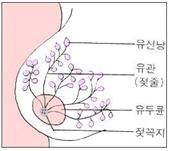
그림 4-5. 모유수유와 유방
Copyright ⓒ 2011 John Sangwon Lee, MD., FAAP

그림 4-6. 모유수유를 할 때 아기의 입과 유방과 젖꼭지의 상관관계도
Copyright ⓒ 2011 John Sangwon Lee, MD., FAAP
임신하지 않은 성인 여성의 유방, 임신한 성인 여성의 유방, 모유수유하는 성인 여성의 유방의 그림 |

그림 4-7. 임신하지 않은 여성의 유방(a), 임신한 여성의 유방(b), 수유하는 여성의 유방(c)을 비교.
-
임신하지 않은 여성의 유방은 가장 작다. 포상샘, 포상샘 분비관, 유동, 젖샘관(유관)이 수유모의 유방에 있는 것들에 비해 훨씬 더 작기 때문이다.
-
임신한 여성의 유방은 모유분비선계가 더 잘 발달되어 있고 더 커졌다.
-
수유하는 여성의 유방은 가장 크고 지방조직이 눈에 띄게 많다. 포상선(포상샘)도 크게 잘 발달됐다. 포상샘 분비관이 더 크고 유동(팽대부)도 더 크고 젖샘관(유관)도 더 크다. 젖꼭지도 유륜도 크다. 소스: Used with permission from Ross Laboratories, Columbus, Ohio 43216, Division of Laboratories, USA와 소아가정간호백과
- The areola naturally contains several Montgomery’s tubercles. Inside these tubercles are Montgomery’s glands, which secrete a creamy, lubricating substance (sebum). This secretion keeps the areola and nipple soft, helping to prevent them from cracking or becoming sore during breastfeeding.
In essence, it is much like applying oil to a machine to ensure it runs smoothly.
Throughout pregnancy and the period of breastfeeding following childbirth, this lubricating secretion serves to protect the nipples and areolae.
You should not wash away this creamy, lubricating secretion—produced by the Montgomery’s glands—with soap. Furthermore, there is no need to apply any special topical creams or ointments to the nipples or areolae.
Q. I have relatively small breasts; will I be able to produce enough breast milk for my baby?
A. Breast size and shape vary significantly from one pregnant woman to another.
Regardless of whether breasts are large or small, sagging or firm, every mother’s breasts are capable of producing enough milk to nourish one—or even two—babies.
From a pediatrician’s perspective, the primary function of the breast is to provide the baby with a sense of security and comfort, while supplying an ample amount of warm breast milk to ensure the baby can feed and grow healthily.
Around the fifth or sixth month of pregnancy, a few drops of clear fluid may begin to leak from the openings in the nipples. This fluid is a form of colostrum, sometimes referred to as “prenatal milk.”
Figure 4-4. The Breast and the Areola
Copyright ⓒ 2011 John Sangwon Lee, MD, FAAP
Figure 4-5. Breastfeeding and the Breast
Copyright ⓒ 2011 John Sangwon Lee, MD, FAAP
Figure 4-6. Diagram showing the relationship between the infant’s mouth, the breast, and the nipple during breastfeeding
Copyright ⓒ 2011 John Sangwon Lee, MD, FAAPIllustrations of the breast in a non-pregnant adult woman, a pregnant adult woman, and a breastfeeding adult woman
Figure 4-7. Comparison of the breast in a non-pregnant woman (a), a pregnant woman (b), and a breastfeeding woman (c).
The breast of a non-pregnant woman is the smallest, as the alveoli, alveolar ducts, lactiferous sinuses, and lactiferous ducts are significantly smaller than those found in the breast of a breastfeeding woman.
In a pregnant woman, the milk-secreting glandular system is more developed and enlarged.
The breast of a breastfeeding woman is the largest and contains a notably greater amount of adipose (fatty) tissue. The alveoli are also well-developed and enlarged. The alveolar ducts, lactiferous sinuses (ampullae), and lactiferous ducts are all larger, and both the nipple and the areola are enlarged. Source: Used with permission from Ross Laboratories, Columbus, Ohio 43216, USA, and the *Encyclopedia of Pediatric and Family Nursing*.
표 성숙 모유, 이행성(변이) 모유, 초유, 우유의 성분 비교표 Composition of mature breast milk, transitional breast milk, colostrum and cow’s milk
모유, 초유 우유성분 |
모유 |
우유 |
||||||
분만 후 15일부터 15개월 동안 분비되는성숙 모유 |
분만 후 6일에서 10일 동안 분비되는이행성 모유 |
분만 후 첫 5일 동안에 분비되는초유 |
||||||
평균 |
시험범위 |
평균 |
시험범위 |
평균 |
시험범위 |
평균 |
시험범위 |
|
칼로리 (kcal/liter) |
||||||||
747 |
446-1192 |
735 |
678-830 |
671 |
588-730 |
701 |
587-876 |
|
ml/liter |
3.127 |
1.867-4.989 |
3.076 |
2.838-3.474 |
2.808 |
2.461-3.055 |
2.934 |
2.457-3.666 |
비중 |
1.031 |
1.026-1.037 |
1.035 |
1.034-1.036 |
1.034 |
– |
1.031 |
1.028-1.033 |
수소 이온 농도 지수 |
7.01 |
6.4-7.6 |
– |
– |
– |
– |
6.6 |
– |
고형질, 총 (g/liter) |
129 |
103-175 |
133 |
105-156 |
128 |
100-167 |
124 |
119-142 |
회분, 총 (g/liter) |
2.02 |
1.6-2.66 |
2.67 |
2.31-3.38 |
3.08 |
2.47-3.50 |
7.15 |
6.81-7.71 |
미네랄 (g/liter) |
– |
– |
– |
– |
– |
– |
– |
– |
양성전자원소 (㎎/liter) |
41 |
– |
55 |
– |
68 |
– |
149 |
0.390-0.139 |
소듐 (g/liter) |
0.172 |
0.064-0.436 |
0.294 |
0.192-0.539 |
0.501 |
0.265-1.37 |
0.768 |
0.392-0.139 |
0.189 |
0.080-0.350 |
0.536 |
0.170-1.21 |
0.956 |
0.330-2.24 |
– |
– |
|
포타슘 (g/liter) |
0.512 |
0.373-0.635 |
0.636 |
0.528-0.769 |
0.745 |
0.658-0.870 |
1.43 |
0.38-2.87 |
0.553 |
0.425-0.735 |
0.692 |
0.450-0.910 |
0.581 |
0.220-0.790 |
– |
– |
|
칼슘 (g/liter) |
0.344 |
0.173-0.609 |
0.464 |
0.23-0.628 |
0.481 |
0.242-0.656 |
1.37 |
0.56-3.81 |
0.271 |
0.207-0.372 |
0.320 |
0.166-0.420 |
0.261 |
0.180-0.364 |
– |
– |
|
마그네슘 (g/liter) |
0.035 |
0.018-0.057 |
0.035 |
0.026-0.054 |
0.042 |
0.031-0.082 |
0.13 |
0.07-0.22 |
음성전자원소 (㎎/liter) |
28 |
– |
37 |
– |
40 |
– |
108 |
– |
인 (g/liter) |
0.141 |
0.068-0.268 |
0.198 |
0.097-0.317 |
0.157 |
0.085-0.251 |
0.91 |
0.56-1.12 |
황 (g/liter) |
0.14 |
0.05-0.30 |
0.20 |
0.15-0.23 |
0.23 |
0.20-0.26 |
0.30 |
0.24-0.36 |
염소 (g/liter) |
0.375 |
0.088-0.734 |
0.457 |
0.305-0.721 |
0.586 |
0.435-1.01 |
1.08 |
0.93-1.41 |
과양성 원소 (㎎/liter) |
13 |
– |
18 |
– |
28 |
– |
41 |
– |
극소물질 |
||||||||
코발트 (㎎/liter) |
극소 |
– |
– |
– |
– |
– |
0.6 |
– |
철 (㎎/liter) |
0.50 |
0.20-0.80 |
0.59 |
0.29-1.45 |
1.0 |
– |
0.45 |
0.25-0.75 |
동 (㎎/liter) |
0.51 |
– |
1.04 |
– |
1.34 |
– |
0.102 |
– |
망간 (㎎/liter) |
극소 |
– |
극소 |
– |
극소 |
– |
0.02 |
0.005-0.0067 |
아연 (㎎/liter) |
1.18 |
0.17-3.02 |
3.82 |
0.39-5.88 |
5.59 |
0.72-9.81 |
3.9 |
1.7-6.6 |
불소 (㎎/liter) |
0.107 |
0.0-0.24 |
– |
– |
0.131 |
0.0-0.35 |
– |
0.10-0.28 |
옥소 (㎎/liter) |
0.061 |
0.044-0.093 |
– |
– |
– |
0.045-0.450 |
0.116 |
0.036-1.05 |
셀레늄 (㎎/liter) |
0.021 |
– |
– |
– |
– |
– |
0.04 |
0.005-0.067 |
단백질 (g/liter) |
||||||||
총 |
10.6 |
7.3-20 |
15.9 |
12.7-18.9 |
22.9 |
14.6-68.0 |
32.46 |
28.16-36.76 |
소스와 참조 문헌: Nelson textbook, 15 Edition p.121,
Pediatric nutrition handbook, American Academy of pediatric, p.354
Comparison of the Composition of Mature Breast Milk, Transitional Breast Milk, Colostrum, and Cow’s Milk
Component
Breast Milk
Cow’s Milk
Mature Breast Milk (secreted from 15 days to 15 months postpartum)
Transitional Breast Milk (secreted from 6 to 10 days postpartum)
Colostrum (secreted during the first 5 days postpartum)
Average
Range
Average
Range
Average
Range
Average
Range
Calories (kcal/liter)
747
446–1192
735
678–830
671
588–730
701
587–876
ml/liter
3.127
1.867–4.989
3.076
2.838–3.474
2.808
2.461–3.055
2.934
2.457–3.666
Specific Gravity
1.031
1.026–1.037
1.035
1.034–1.036
1.034
–
1.031
1.028–1.033
pH (Hydrogen ion concentration)
7.01
6.4–7.6
–
–
–
–
6.6
–
Total solids (g/liter)
129
103–175
133
105–156
128
100–167
124
119–142
Total ash (g/liter)
2.02
1.6–2.66
2.67
2.31–3.38
3.08
2.47–3.50
7.15
6.81–7.71
Minerals (g/liter)
–
–
–
–
–
–
–
–
Cationic elements (mg/liter)
41
–
55
–
68
–
149
0.390–0.139
Sodium (g/liter)
0.172
0.064–0.436
0.294
0.192–0.539
0.501
0.265–1.37
0.768
0.392–0.139
0.189
0.080–0.350
0.536
0.170–1.21
0.956
0.330–2.24
–
–
Potassium (g/liter)
0.512
0.373–0.635
0.636
0.528–0.769
0.745
0.658–0.870
1.43
0.38–2.87
0.553
0.425–0.735
0.692
0.450–0.910
0.581
0.220–0.790
–
–
Calcium (g/liter)
0.344
0.173–0.609
0.464
0.23–0.628
0.481
0.242–0.656
1.37
0.56–3.81
0.271
0.207–0.372
0.320
0.166–0.420
0.261
0.180–0.364
–
–
Magnesium (g/liter)
0.035
0.018–0.057
0.035
0.026–0.054
0.042
0.031–0.082
0.13
0.07–0.22
Minor elements (mg/liter)
28
–
37
–
40
–
108
–
Phosphorus (g/liter)
0.141
0.068–0.268
0.198
0.097–0.317
0.157
0.085–0.251
0.91
0.56–1.12
Sulfur (g/liter)
0.14
0.05–0.30
0.20
0.15–0.23
0.23
0.20–0.26
0.30
0.24–0.36
Chlorine (g/liter)
0.375
0.088–0.734
0.457
0.305–0.721
0.586
0.435–1.01
1.08
0.93–1.41
Trace elements (mg/liter)
13
–
18
–
28
–
41
–
Trace substances
Cobalt (mg/liter)
Trace
–
–
–
–
–
0.6
–
Iron (mg/liter)
0.50
0.20–0.80
0.59
0.29–1.45
1.0
–
0.45
0.25–0.75
Copper (mg/liter)
0.51
–
1.04
–
1.34
–
0.102
–
Manganese (mg/liter)
Trace
–
Trace
–
Trace
–
0.02
0.005–0.0067
Zinc (mg/liter)
1.18
0.17–3.02
3.82
0.39–5.88
5.59
0.72–9.81
3.9
1.7–6.6
Fluorine (mg/liter)
0.107
0.0–0.24
–
–
0.131
0.0–0.35
–
0.10–0.28
Iodine (mg/liter)
0.061
0.044–0.093
–
–
–
0.045–0.450
0.116
0.036–1.05
Selenium (mg/liter)
0.021
–
–
–
–
–
0.04
0.005–0.067
Protein (g/liter)
Total
10.6
7.3–20
15.9
12.7–18.9
22.9
14.6–68.0
32.46
28.16–36.76
Source and references: Nelson Textbook, 15th Edition, p. 121
그 외
모유, 초유 우유성분 |
모유 |
우유 |
|||||||
분만 후 15일부터 15개월 동안 분비되는 성숙 모유 |
분만 후 6일에서 10일 동안 분비되는 이행성 모유 |
분만 후 첫 5일 동안에 분비되는 초유 |
|||||||
성분 |
평균 |
시험범위 |
평균 |
시험범위 |
평균 |
시험범위 |
평균 |
시험범위 |
|
탄수화물 |
|||||||||
유당 |
|||||||||
직접추정 (g/liter) |
71 |
49-95 |
64 |
61-67 |
57 |
11-79 |
47 |
49-50 |
|
차이 |
68 |
50-92 |
64 |
60-68 |
– |
– |
– |
– |
|
과당 (g/liter) |
1.3 |
– |
– |
– |
– |
– |
– |
– |
|
글루코사민 (g/liter) |
– |
0.7-0.8 |
– |
– |
– |
1.4-4.3 |
0 |
– |
|
갈락토사민 (g/liter) |
– |
0.0-0.4 |
– |
– |
– |
0.04-0.7 |
0 |
– |
|
이노시톨 (g/liter) |
0.45 |
0.39-0.56 |
– |
– |
– |
– |
0.08 |
0.06-0.12 |
|
구연산 (g/liter) |
– |
0.35-1.25 |
– |
– |
– |
– |
2.54 |
2.15-2.9 |
|
지방, 총 (g/liter) |
45.4 |
13.4-82.9 |
35.2 |
27.3-51.8 |
29.5 |
24.7-31.8 |
38.0 |
34.0-61.0 |
|
콜레스테롤 (㎎/liter) |
139 |
88-202 |
241 |
126-320 |
280 |
180-345 |
110 |
70-170 |
|
자유콜레스테롤 (총양의 %) |
76.1 |
– |
76.5 |
– |
79.5 |
– |
– |
90-95 |
|
인 지질 (㎎/liter) |
10.5 |
7-14 |
15.5 |
11-20 |
12 |
6-17 |
– |
53-70 |
|
비타민 |
|||||||||
비타민A (㎎/liter) |
0.61 |
0.15-2.26 |
0.88 |
0.58-1.83 |
1.61 |
0.75-3.05 |
0.27 |
0.17-0.38 |
|
캐토틴 (㎎/liter) |
0.25 |
0.02-0.77 |
0.38 |
0.23-0.63 |
1.37 |
0.41-3.85 |
0.37 |
0.12-0.79 |
|
비타민 D (IU/liter) |
– |
4-100 |
– |
– |
– |
– |
– |
5.40 |
|
토코페롤 (㎎/liter) |
2.4 |
1.0-4.8 |
8.9 |
4.0-18.5 |
14.8 |
2.8-30.0 |
0.6 |
0.2-1.0 |
|
지아민 (㎎/liter) |
0.142 |
0.081-0.227 |
0.059 |
0.023-0.105 |
0.019 |
0.009-0.034 |
0.43 |
0.28-0.900 |
|
리보플라빈 (㎎/liter) |
0.373 |
0.198-0.790 |
0.369 |
0.275-0.490 |
0.302 |
0.120-0.453 |
1.56 |
1.16-2.02 |
|
비타민 B6 (㎎/liter) |
0.18 |
0.10-0.22 |
– |
– |
– |
– |
0.51 |
0.40-0.63 |
|
니코틴 산 (㎎/liter) |
1.83 |
0.66-3.30 |
1.75 |
0.60-3.60 |
0.75 |
0.50-14.5 |
0.74 |
0.50-0.86 |
|
비타민 B₁₂ (㎍/liter) |
– |
극소량 |
0.36 |
0.03-0.70 |
0.45 |
0.10-1.5 |
6.6 |
3.2-12.4 |
|
엽산 (IU/liter) |
|||||||||
(a) |
1.4 |
0.9-1.8 |
0.2 |
0.15-0.25 |
0.5 |
0.10-1.5 |
1.3 |
0.2-4.0 |
|
(b) |
24.0 |
7.4-61.0 |
– |
– |
– |
– |
37.7 |
16.8-63.2 |
|
(c) |
7.3 |
2.3-17.6 |
– |
– |
– |
– |
12.6 |
2.8-43.6 |
|
바이오틴 (IU/liter) |
2 |
1-3 |
– |
– |
– |
– |
22 |
14-29 |
|
펜토테닉산 |
2.46 |
0.86-5.84 |
2.88 |
1.35-4.12 |
1.83 |
0.29-3.02 |
3.4 |
2.2-5.5 |
|
비타민 C |
52 |
0-112 |
71 |
45-90 |
72 |
47-104 |
11 |
3-23 |
|
소스: From George DR, De Francesca BA.Human milk in comparison to cow milk.in: Lebenthal E, ed. Textbook of Gastroenterology and Nutrition in Infancy and Childhood. 2nd ed. New York, NY: Raven Press; 1989:242-243 |
모유 초유 우유성분 |
모유 |
우유 |
||||||
분만 후 15일부터 15개월 동안 분비되는 성숙 모유 |
분만 후 6일에서 10일 동안 분비되는 이행성 모유 |
분만 후 첫 5일 동안에 분비되는 초유 |
||||||
평균 |
시험범위 |
평균 |
시험범위 |
평균 |
시험범위 |
평균 |
시험범위 |
|
카세인 |
3.7 |
1.4-6.8 |
5.1 |
4.2-5.9 |
21 |
7.3-52 |
24.9 |
21.9-28.0 |
유장단백질 |
7 |
4-10 |
– |
– |
– |
– |
7 |
6-10 |
유알부민 |
3.6 |
1.4-6.0 |
7.8 |
6.9-8.6 |
– |
– |
2.4 |
1.4-3.3 |
유글로블린 |
– |
– |
5.0 |
2.1-13.6 |
35 |
4.2-133 |
1.7 |
0.7-3.7 |
혈청앨부민 |
0.32 |
0.20-0.47 |
0.37 |
0.26-0.65 |
2.5 |
– |
0.4 |
– |
혈청면역글로부민 |
0.09 |
0.02-0.27 |
0.36 |
0.01-0.96 |
1.0 |
– |
0.8 |
– |
아미노산 (g/liter) |
||||||||
총 |
12.8 |
9.0-16.0 |
9.4 |
6.0-10.0 |
12.0 |
7.0-40.0 |
33.0 |
27.0-41.0 |
알라닌 |
– |
0.36-0.42 |
– |
– |
– |
– |
0.75 |
– |
아르지닌 |
0.43 |
0.28-0.64 |
0.63 |
0.48-0.73 |
0.74 |
0.62-0.96 |
1.4 |
1.2-1.6 |
아스파틱산 |
– |
0.89-0.98 |
– |
– |
– |
– |
1.7 |
– |
시스틴 |
– |
0.23-0.25 |
– |
– |
– |
– |
– |
– |
글루탐산 |
– |
1.89-2.00 |
– |
– |
– |
– |
6.8 |
– |
글라이신 |
– |
0.23-0.24 |
– |
– |
– |
– |
0.11 |
– |
히스티딘 |
0.24 |
0.12-0.30 |
0.38 |
0.29-0.45 |
0.41 |
0.35-0.46 |
1.2 |
1.1-1.3 |
이소류신 |
0.61 |
0.41-0.92 |
0.97 |
0.73-1.21 |
1.01 |
0.88-1.15 |
2.5 |
2.1-2.9 |
류신 |
0.97 |
0.65-1.47 |
1.51 |
1.13-1.97 |
1.66 |
1.33-2.14 |
3.6 |
3.2-3.9 |
리신 |
0.70 |
0.36-0.93 |
1.13 |
0.88-1.48 |
1.18 |
0.95-1.41 |
2.6 |
2.3-3.1 |
메티소닌 |
1.12 |
0.07-0.16 |
0.24 |
0.16-0.34 |
0.25 |
0.19-0.36 |
0.8 |
0.6-0.9 |
페닐알라인 |
0.40 |
0.24-0.58 |
0.62 |
0.48-0.71 |
0.70 |
0.60-0.84 |
1.8 |
1.5-2.2 |
프롤린 |
– |
0.84-0.94 |
– |
– |
– |
– |
2.5 |
– |
세린 |
– |
0.47-0.51 |
– |
– |
– |
– |
1.6 |
– |
트리오닌 |
0.52 |
0.30-0.66 |
0.78 |
0.61-0.91 |
0.85 |
0.75-1.04 |
1.7 |
1.3-2.2 |
트림토판 |
0.19 |
0.14-0.26 |
0.28 |
0.23-0.32 |
0.32 |
0.25-0.42 |
0.6 |
0.4-0.8 |
티로신 |
– |
0.46-0.52 |
– |
– |
– |
– |
– |
– |
발린 |
0.73 |
0.45-1.14 |
1.05 |
0.77-1.36 |
1.17 |
0.98-1.49 |
2.6 |
2.4-2.8 |
비단백 요소 (mg/liter) |
||||||||
총 |
324 |
173-604 |
479 |
425-533 |
910 |
510-1270 |
252 |
181-323 |
요소-N |
180 |
127-235 |
111 |
– |
– |
– |
132.7 |
61.3-204 |
요산-N |
22 |
13-41 |
– |
– |
– |
– |
24.1 |
11.3-36.9 |
크레아티닌-N |
11 |
8-19 |
– |
– |
– |
– |
7.05 |
1.9-12.2 |
크레아틴-N |
11 |
2-41 |
– |
– |
– |
– |
40.35 |
24.5-56.2 |
아미노산-N |
50 |
28-113 |
44 |
– |
– |
40-120 |
6.8 |
1.7-11.9 |
콜린-N |
10.3 |
6.2-16.8 |
– |
– |
– |
– |
12 |
5-19 |
효소 (mg/liter) |
||||||||
라이조잠 |
390 |
30-3000 |
– |
– |
460 |
90-1020 |
0.13 |
0.00-2.6 |
소스: From George DR, De Francesca BA.Human milk in comparison to cow milk.in: Lebenthal E, ed. Textbook of Gastroenterology and Nutrition in Infancy and Childhood. 2nd ed. New York, NY: Raven Press; 1989:242-243
Source and references: Nelson Textbook, 15th Edition, p. 121
Others
Breast milk, Colostrum, Cow’s milk
Components
Breast milk
Cow’s milk
Mature breast milk (secreted from 15 days to 15 months postpartum)
Transitional breast milk (secreted from 6 to 10 days postpartum)
Colostrum (secreted during the first 5 days postpartum)
Components
Average
Range
Average
Range
Average
Range
Average
Range
Carbohydrates
Lactose
Direct estimation (g/liter)
71
49–95
64
61–67
57
11–79
47
49–50
Difference
68
50–92
64
60–68
–
–
–
–
Fructose (g/liter)
1.3
–
–
–
–
–
–
–
Glucosamine (g/liter)
–
0.7–0.8
–
–
–
1.4–4.3
0
–
Galactosamine (g/liter)
–
0.0–0.4
–
–
–
0.04–0.7
0
–
Inositol (g/liter)
0.45
0.39-0.56
–
–
–
–
0.08
0.06-0.12
Citric acid (g/liter)
–
0.35-1.25
–
–
–
–
2.54
2.15-2.9
Total fat (g/liter)
45.4
13.4-82.9
35.2
27.3-51.8
29.5
24.7-31.8
38.0
34.0-61.0
Cholesterol (mg/liter)
139
88-202
241
126-320
280
180-345
110
70-170
Free cholesterol (% of total amount)
76.1
–
76.5
–
79.5
–
–
90-95
Phospholipids (mg/liter)
10.5
7-14
15.5
11-20
12
6-17
–
53-70
Vitamins
Vitamin A (mg/liter)
0.61
0.15–2.26
0.88
0.58–1.83
1.61
0.75–3.05
0.27
0.17–0.38
Carotene (mg/liter)
0.25
0.02–0.77
0.38
0.23–0.63
1.37
0.41–3.85
0.37
0.12–0.79
Vitamin D (IU/liter)
–
4–100
–
–
–
–
–
5.40
Tocopherol (mg/liter)
2.4
1.0–4.8
8.9
4.0–18.5
14.8
2.8–30.0
0.6
0.2–1.0
Thiamine (mg/liter)
0.142
0.081–0.227
0.059
0.023–0.105
0.019
0.009–0.034
0.43
0.28–0.900
Riboflavin (mg/liter)
0.373
0.198–0.790
0.369
0.275–0.490
0.302
0.120–0.453
1.56
1.16–2.02
Vitamin B6 (mg/liter)
0.18
0.10–0.22
–
–
–
–
0.51
0.40–0.63
Nicotinic acid (mg/liter)
1.83
0.66–3.30
1.75
0.60–3.60
0.75
0.50–14.5
0.74
0.50–0.86
Vitamin B12 (µg/liter)
–
Trace amounts
0.36
0.03–0.70
0.45
0.10–1.5
6.6
3.2–12.4
Folic acid (IU/liter)
(a)
1.4
0.9–1.8
0.2
0.15–0.25
0.5
0.10–1.5
1.3
0.2–4.0
(b)
24.0
7.4–61.0
–
–
–
–
37.7
16.8–63.2
(c)
7.3
2.3–17.6
–
–
–
–
12.6
2.8–43.6
Biotin (IU/liter)
2
1–3
–
–
–
–
22
14–29
Pantothenic acid
2.46
0.86–5.84
2.88
1.35–4.12
1.83
0.29–3.02
3.4
2.2–5.5
Vitamin C
52
0–112
71
45–90
72
47–104
11
3–23
Source: From George DR, De Francesca BA. Human milk in comparison to cow milk. In: Lebenthal E, ed. Textbook of Gastroenterology and Nutrition in Infancy and Childhood. 2nd ed. New York, NY: Raven Press; 1989:242–243
각종 병원체나 항원에 의해 침입 당했을 때 병원체나 항원과 싸워 감염병이나 알레르기 질병 등이 생기지 않게 하는 역할을 하는 백혈구, 거대세포, 항체 등이 모유 속에 들어 있다. |
표 모유, 우유, 양유, 인공영양의 성분 비교표 Composition of breast milk, cow’s milk, goat’s milk, infant formula

표 1-1(2).

※ 인공영양의 성분과 성분의 용량이 다소 변경될 수 있다.
최근 거의 모든 인공영양에 DHA와 ARA의 성분이 포함되어 있다. 소스: 부모도 반의사가 되어야 한다―소아가정간호백과
출처 및 참조 문헌
-
www.drleepediatrics.com 제1권 소아청소년 응급 의료
-
www.drleepediatrics.com 제2권 소아청소년 예방
-
www.drleepediatrics.com 제3권 소아청소년 성장 발육 육아
-
www.drleepediatrics.com 제4권 모유,모유수유, 이유
-
www.drleepediatrics.com 제5권 인공영양, 우유, 이유식, 비타민, 미네랄, 단백질, 탄수화물, 지방
-
www.drleepediatrics.com 제6권 신생아 성장 발육 육아 질병
-
www.drleepediatrics.com제7권 소아청소년 감염병
-
www.drleepediatrics.com제8권 소아청소년 호흡기 질환
-
www.drleepediatrics.com제9권 소아청소년 소화기 질환
-
www.drleepediatrics.com제10권. 소아청소년 신장 비뇨 생식기 질환
-
www.drleepediatrics.com제11권. 소아청소년 심장 혈관계 질환
-
www.drleepediatrics.com제12권. 소아청소년 신경 정신 질환, 행동 수면 문제
-
www.drleepediatrics.com제13권. 소아청소년 혈액, 림프, 종양 질환
-
www.drleepediatrics.com제14권. 소아청소년 내분비, 유전, 염색체, 대사, 희귀병
-
www.drleepediatrics.com제15권. 소아청소년 알레르기, 자가 면역질환
-
www.drleepediatrics.com제16권. 소아청소년 정형외과 질환
-
www.drleepediatrics.com제17권. 소아청소년 피부 질환
-
www.drleepediatrics.com제18권. 소아청소년 이비인후(귀 코 인두 후두) 질환
-
www.drleepediatrics.com제19권. 소아청소년 안과 (눈)질환
-
www.drleepediatrics.com 제20권 소아청소년 이 (치아)질환
-
www.drleepediatrics.com 제21권 소아청소년 가정 학교 간호
-
www.drleepediatrics.com 제22권 아들 딸 이렇게 사랑해 키우세요
-
www.drleepediatrics.com 제23권 사춘기 아이들의 성장 발육 질병
-
www.drleepediatrics.com 제24권 소아청소년 성교육
-
www.drleepediatrics.com 제25권 임신, 분만, 출산, 신생아 돌보기
-
Red book 29th-31st edition 2021
-
Nelson Text Book of Pediatrics 19th- 21st Edition
-
The Johns Hopkins Hospital, The Harriet Lane Handbook, 22nd edition
-
응급환자관리 정담미디어
-
소아가정간호백과–부모도 반의사가 되어야 한다, 이상원
-
Neonatal Resuscitation American heart Association
-
Neonatology Jeffrey J.Pomerance, C. Joan Richardson
-
Pediatric Resuscitation Pediatric Clinics of North America, Stephen M. Schexnayder, M.D.
-
Pediatric Critical Care, Pediatric Clinics of North America, James P. Orlowski, M.D.
-
Preparation for Birth. Beverly Savage and Dianna Smith
-
Infectious disease of children, Saul Krugman, Samuel L Katz, Ann A. Gershon, Catherine Wilfert
-
Pediatric Nutritional Handbook American Academy of Pediatrics
-
소아가정간호백과–부모도 반의사가 되어야 한다, 이상원
-
The pregnancy Bible. By Joan stone, MD. Keith Eddleman, MD
-
Neonatology Jeffrey J. Pomerance, C. Joan Richardson
-
Preparation for Birth. Beverly Savage and Dianna Smith
-
임신에서 신생아 돌보기까지. 이상원
-
Breastfeeding by Ruth Lawrence and Robert Lawrence
-
Infectious disease of children, Saul Krugman, Samuel L Katz, Ann A. Gershon, Catherine Wilfert
-
The Harriet Lane Handbook 19th Edition
-
제4권 모유, 모유수유, 이유 참조문헌 및 출처
-
제5권 인공영양, 우유, 이유, 비타민, 단백질, 지방 탄수 화물 참조문헌 및 출처
-
제6권 신생아 성장발육 양호 질병 참조문헌 및 출처
-
소아과학 대한교과서
-
그 외
Copyright ⓒ 2015 John Sangwon Lee, MD., FAAP미국 소아과 전문의, 한국 소아청소년과 전문의 이상원 저 “부모도 반의사가 되어야 한다”-내용은 여러분들의 의사로부터 얻은 정보와 진료를 대신할 수 없습니다.“The information contained in this publication should not be used as a substitute for the medical care and advice of your doctor. There may be variations in treatment that your doctor may recommend based on individual facts and circumstances. “Parental education is the best medicine.”Copyright drleepediatrics.com 2/17/2026
Breast milk contains white blood cells, macrophages, and antibodies that fight against invading pathogens or antigens, helping to prevent the development of infectious diseases, allergies, and other conditions. Table: Comparison of the composition of breast milk, cow’s milk, goat’s milk, and infant formula. |