궤양성 대장염과 크론병
Ulcerative colitis and Crohn’s disease
posted in: Uncategorized | 0
궤양성 대장염과 크론 병의 원인
- 이 두 병의 원인은 확실히 모르나 이 두 병을 만성 자가면역 염증성 장병(Chronic, autoimmune inflammatory bowel disease/IBD)이라 한다.
- 이 두 병은 소아청소년들에게도 생길 수 있고 성인들에게도 생길 수도 있다. 15~25세에 더 잘 생긴다.
- 유전, 자가면역 이상과 환경 요인에 의해서 생긴다고 믿기도 한다.
- 이 두 병은 어떤 인자로 유발되고, 그 외 박테리아(세균) 감염이나 세균 독소 등으로 생긴다는 설도 있다.
- 크론병은 만성으로 진행되면서 섬유화로 위장관 폐쇄도 생길 수 있고 장 누공도 생길 수 있고 종양도 생길 수 있다.
- Crohn’s disease is a type of inflammatory bowel disease (IBD). It causes inflammation of your digestive tract, which can lead to abdominal pain, severe diarrhea, fatigue, weight loss and malnutrition. Inflammation caused by Crohn’s disease can involve different areas of the digestive tract in different people.
- 식도, 위, 소장, 대장. 직장 , 맹장, 항문 등 전 위장관의 일부 또는 전체에 크론병이 생길 수 있다.
궤양성 대장염과 크론병의 증상 징후
- 이 병의 증상, 징후는 다양하고 복잡하다.
- 소장이나 대장에 원인불명의 염증이 생겨 그로 인해서 여러 가지 증상 징후가 생긴다.
- 염증성 장질환의 중증도, 치료, 합병증 등에 따라 증상 징후가 많이 다르다.
- 적절히 치료하면 염증성 장 질환이 완화될 수 있다.
- 염증성 장질환의 증상 징후가 재유발되는 경우가 많고 적절히 치료해도 이 두 병은 일생 동안 진행되는 것이 보통이다.
- 이 병은 전 세계 어느 민족의 누구에게도 생길 수 있고, 무슨 이유인지 최근에는 발생 빈도가 더 증가하는 추세에 있다.
- 사춘기 이전 소아들에게서 발생하는 빈도보다 사춘기 아이들에게 발생하는 빈도가 더 높다.
- 때로는 장관 누관, 농양, 협착증이 있어 그때 크론병을 진단할 수 있다.
성인들에게 생기는 염증성 장염과 소아청소년들에게 생기는 염증성 장염의 비교
- 유사점
-
- 피로, 열, 복통, 설사, 체중 감소, 직장 출혈, 구강 통증, 대변이 갑자가 매렵고, 식욕이 없고 눈이 가렵고 홍채 염채염등이 생길 길 수도 있고 무릎 관절영, 고관절염, 팔꿈치 관절염도 생길 수 있고 피부염 등의 증상징후가 있을 수 있는 것은 거의 같다
- 크론 병이 생긴 소장관의 부위도 비슷하다.
- 치료 효과도 비슷하다.
- 크론병을 수술로 치료한 후 재유발 빈도도 거의 비슷하다.
- 차이점
-
- 크론병이 궤양성 대장염보다 소아청소년들에게 더 흔히 생긴다.
- 소아청소년들에게 생긴 궤양성 대장염은 전체의 대장에 생기는 경향이 더 많고 성장 지연이 생기고 사춘기의 2차 성장 발육이 늦게 올 수 있다.
- 모르는 점
-
- 원인과 그 병의 진행 과정은 확실히 모른다.
궤양성 대장염과 크론 병의 증상 징후의 비교
- 복통-크론 병에서 62~95%, 궤양성 대장염에서 33~71% 생긴다.
- 설사-크론병에서 66~77%, 궤양성 대장염에서 67~90% 생긴다.
- 체중감소-크론병에서 80~97%, 궤양성 대장염에서 39~43% 생긴다.
- 직장출혈-크론병에서 14~40%, 궤양성 대장염에서 52~90% 생긴다.
- 성장지연-크론병에서 30~33%, 궤양성 대장염에서 6% 생긴다.
- 직장 주위 염증-크론병에서 25%, 궤양성 대장염에서 0% 생긴다.
- 소화계통 이외의 신체의 다른 계통의 다른 기관이나 조직에 생기는 증상 징후-크론 크론병에서 15~25%, 궤양성 대장염에서 2~16% 생긴다.
- 크론병이 있으면 점액이 섞인 설사변을 볼 수 있고 환자의 ⅓에서 변비증이 있을 수 있고 뒤가 무질근하고 불완전 배변이 있을 수 있고 쉽게 피로가 있다.
- 궤양성 직장염(Proctitis)의 대부분은 궤양성 대장염의 일부분이다.
- 크론병을 앓는 아이들의 30%는 19세 이하의 미성년들이다. 체중 감소,성장 지연, 원인불명의 미열, 관절통, 관절염, 간염, 황달, 눈 통증, 지속성 결막염, 빈혈, 이차 성징 발육지연, 곤봉상 손가락 지절, 구강 내 궤양, 복강 내 덩어리, 항문 주위 열창, 빈혈, 요석증, 폐렴, 구강내 점막 건조증, 대변 잠재혈액, 결절성 홍반 등의 증상 징후가 생길 수 있다. 대장암이나 직장암의 발생률도 더 높다.
Ulcerative Colitis and Crohn’s Disease
Posted in: Uncategorized | 0
Causes of Ulcerative Colitis and Crohn’s Disease
While the exact causes of these two conditions remain unknown, they are classified as chronic, autoimmune inflammatory bowel diseases (IBD).
Both conditions can affect children, adolescents, and adults, with a higher incidence observed between the ages of 15 and 25.
It is believed that they arise from a combination of genetic factors, autoimmune abnormalities, and environmental influences.
There are also theories suggesting that these conditions may be triggered by specific factors, or potentially by bacterial infections or bacterial toxins.
Crohn’s disease can progress into a chronic state, potentially leading to complications such as fibrosis-related gastrointestinal obstruction, fistulas, or the development of tumors.
Crohn’s disease is a type of inflammatory bowel disease (IBD). It causes inflammation of your digestive tract, which can lead to abdominal pain, severe diarrhea, fatigue, weight loss, and malnutrition. The inflammation caused by Crohn’s disease can affect different areas of the digestive tract in different individuals.
Crohn’s disease can occur in any part—or the entirety—of the gastrointestinal tract, including the esophagus, stomach, small intestine, large intestine, rectum, cecum, and anus.
Signs and Symptoms of Ulcerative Colitis and Crohn’s Disease
The signs and symptoms of these conditions are diverse and complex.
Inflammation of unknown origin in the small or large intestine gives rise to a wide range of clinical signs and symptoms. The signs and symptoms of inflammatory bowel disease (IBD) vary significantly depending on the severity of the condition, the treatment provided, and the presence of complications.
With appropriate treatment, IBD can be brought into remission.
However, symptoms often recur, and even with proper management, these conditions typically persist throughout a person’s lifetime.
IBD can affect anyone, regardless of ethnicity or background, and for reasons that remain unclear, its incidence has been on the rise recently.
It occurs more frequently in adolescents than in children who have not yet reached puberty.
In some cases, the diagnosis of Crohn’s disease is made only after the development of complications such as intestinal fistulas, abscesses, or strictures.
Comparison of Inflammatory Bowel Disease in Adults versus Children and Adolescents
Similarities
The signs and symptoms—including fatigue, fever, abdominal pain, diarrhea, weight loss, rectal bleeding, oral pain, a sudden, urgent need to defecate, loss of appetite, eye irritation (such as iritis), arthritis (affecting the knees, hips, or elbows), and various skin conditions—are largely the same.
The specific locations within the small intestine affected by Crohn’s disease are also similar.
Treatment outcomes are comparable.
The rate of recurrence following surgical intervention for Crohn’s disease is also very similar.
Differences
Crohn’s disease is more common than ulcerative colitis among children and adolescents. In children and adolescents, ulcerative colitis tends to affect the entire colon; it can lead to growth retardation and a delayed onset of secondary sexual development during puberty.
Unknown aspects
The exact cause and the progression of the disease remain unclear.
Comparison of symptoms and signs: Ulcerative colitis vs. Crohn’s disease
Abdominal pain: Occurs in 62–95% of Crohn’s disease cases and 33–71% of ulcerative colitis cases.
Diarrhea: Occurs in 66–77% of Crohn’s disease cases and 67–90% of ulcerative colitis cases.
Weight loss: Occurs in 80–97% of Crohn’s disease cases and 39–43% of ulcerative colitis cases.
Rectal bleeding: Occurs in 14–40% of Crohn’s disease cases and 52–90% of ulcerative colitis cases.
Growth retardation: Occurs in 30–33% of Crohn’s disease cases and 6% of ulcerative colitis cases.
Perianal inflammation: Occurs in 25% of Crohn’s disease cases and 0% of ulcerative colitis cases.
Extraintestinal manifestations (symptoms or signs affecting organs or tissues outside the digestive system): Occur in 15–25% of Crohn’s disease cases and 2–16% of ulcerative colitis cases.
In Crohn’s disease, patients may experience diarrhea mixed with mucus; one-third of patients may also suffer from constipation, a sensation of incomplete evacuation (tenesmus), and easy fatigability. In most cases, proctitis is a manifestation of ulcerative colitis.
Thirty percent of individuals with Crohn’s disease are under the age of 19. Potential signs and symptoms include weight loss, growth retardation, unexplained low-grade fever, joint pain, arthritis, hepatitis, jaundice, eye pain, persistent conjunctivitis, anemia, delayed development of secondary sexual characteristics, clubbing of the fingers, oral ulcers, intra-abdominal masses, perianal fissures, urolithiasis, pneumonia, dry oral mucosa, fecal occult blood, and erythema nodosum. There is also an increased risk of developing colon or rectal cancer.
궤양성 대장염과 크론 병의 진단
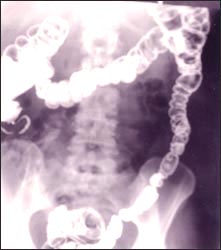
사진 78. 대장 바륨 X선 검사.
Copyright ⓒ 2011 John Sangwon Lee, MD, FAAP
- 병력, 증상 징후, 진찰소견 등을 종합해서 이 병이 의심되면 CBC 피 검사, 적혈구 침강속도 검사, 혈중 단백 검사, 대변 세균검사, 대변 기생충검사, 대변 잠재혈액 검사 등 임상검사, 위장 바륨 X-선 검사, 복부 CT 스캔 검사, 골반 강 CT 스캔 검사, WBC 스캔 검사, 식도위장 내시경 검사, 회장 내시경검사, 위장 벽 점막층 생체 조직검사 등으로 진단한다.
- 소아청소년 위장 질환 전문의, 방사능 전문의, 핵의학 전문의, 내시경 전문의, 소아 외과 전문의, 병리학 전문의 등이 한 진단 치료 팀의 멤버가 상호 협조해서 진단 치료하는 것이 이상적이다.
- Calprotectin is released by white blood cells (neutrophils) in the digestive tract during inflammation. Calprotectin 검사 결과가 높고 c 반응 검사와 ESR 검사 결과도 높게 나온다.
궤양성 대장염과 크론 병의 치료
- 소아청소년 위장 질환과 전문의, 방사능 전문의, 핵의학 전문의, 내시경 전문의, 소아청소년 외과 전문의, 병리학 전문의, 안과 전문의, 피부과 전문의, 내분비 전문의, 사회복지사, 영양사 등이 한 치료팀의 멤버가 되어 상호 협조해서 치료하는 것이 보통이다.
- 염증성 장 질환은 경도, 중등도, 중증도로 분리된다.
- 소아 크론병 환아를 치료할 때는 골 연령을 주기적으로 측정하는 것을 권장 한다. 소스:Contemporary Pediatrics Jun 7, 2012
궤양성 대장염과 크론병을 다음 약물로 치료한다.
- Prednisone, Budsonide, Methylprednisolone, Hydrocortisone, 또는 Infliximab 등으로 크론병 완화치료를 하고,
- 6-mercaptopurine, Azathioprine, Methotrexate, 5-aminosalicylates(Mesalamine 또는 Balsalazide), 또는 Infliximab 등으로 크론병 완화 유지치료를 할 수 있다.
- Prednisone, 5-aminosalicylates(Mesalamine 또는 Balsalazide), Infliximab, 또는 Cyclosporine 등으로 궤양성 대장염 완화치료를 하고 6-mercaptopurine, Azathioprine, 5-aminosalicylates(Mesalamine 또는 Balsalazide), Cyclosporine 등으로 궤양성 대장염 완화 유지치료를 할 수 있다.
- 그 중증도에 따라 비코르티코스테로이드, 코르티코스테로이드제 항 항염증제로 치료하는 것이 보통이다.
- 필요에 따라 직장절제수술이나 절제수술로 치료할 수 있다.
- 코르티코스테로이드제를 대장관 내에 직접 주입해서 치료하거나 코르티코스테로이드제 정맥 주사로 치료하기도 한다.
- 대장 악성종양, 성장 중지, 일상생활을 정상적으로 유지할 수 없을 때, 치료약물에 부작용이 심할 때, 약물 치료 효과가 없을 때, 장천공, 심한 위장출혈, 심한 대장염 등이 있을 때는 수술로 치료할 때도 있다.
- 균형 잡힌 영양 음식물을 섭취하는 것도 중요하고 체중이 정상적으로 증가하지 않고 성장 지연이 생기지 않게 예방하기 위해 적절한 영양 공급이 절대적으로 필요하다.
- 때로는 영아 포물라를 경구로 공급하든지 비위 피딩관(비위급식관)으로 영아 포물라를 공급하기도 한다. 필요에 따라 영양사의 도움을 받는다.
- 환아와 전 가족에 생긴 불안과 스트레스를 치료받고 환아의 학교 문제에 대해서 도움을 받아야 한다. 그리고 경제적·사회적 문제에 대해서 사회복지사의 도움을 받아야 한다.
Diagnosis of Ulcerative Colitis and Crohn’s Disease
Image 78. Barium X-ray examination of the large intestine.
Copyright © 2011 John Sangwon Lee, MD, FAAP
When these conditions are suspected based on a comprehensive assessment of medical history, signs and symptoms, and physical examination findings, diagnosis is pursued through various methods. These include clinical laboratory tests—such as a complete blood count (CBC), erythrocyte sedimentation rate (ESR), serum protein analysis, and stool examinations for bacteria, parasites, and occult blood—as well as imaging studies like barium X-rays of the gastrointestinal tract, abdominal and pelvic CT scans, and white blood cell (WBC) scans. Additionally, endoscopic procedures—such as esophagogastroduodenoscopy and ileoscopy—along with biopsies of the gastrointestinal mucosal lining are used to establish a diagnosis.
Ideally, diagnosis and treatment are managed by a collaborative multidisciplinary team consisting of specialists in pediatric gastroenterology, radiology, nuclear medicine, endoscopy, pediatric surgery, and pathology.
Calprotectin is released by white blood cells (neutrophils) in the digestive tract during inflammation. Elevated levels of calprotectin, as well as high results on C-reactive protein (CRP) and ESR tests, are typically observed.
Treatment of Ulcerative Colitis and Crohn’s Disease
Treatment is generally carried out by a collaborative multidisciplinary team that may include specialists in pediatric gastroenterology, radiology, nuclear medicine, endoscopy, pediatric surgery, pathology, ophthalmology, dermatology, and endocrinology, as well as social workers and dietitians.
Inflammatory bowel disease (IBD) is classified into mild, moderate, and severe categories. For pediatric patients with Crohn’s disease, periodic assessment of bone age is recommended. Source: Contemporary Pediatrics, June 7, 2012.
Ulcerative colitis and Crohn’s disease are treated with the following medications:
Crohn’s disease can be managed with induction therapy using agents such as prednisone, budesonide, methylprednisolone, hydrocortisone, or infliximab. Maintenance therapy for Crohn’s disease may involve 6-mercaptopurine, azathioprine, methotrexate, 5-aminosalicylates (mesalamine or balsalazide), or infliximab.
Ulcerative colitis can be managed with induction therapy using agents such as prednisone, 5-aminosalicylates (mesalamine or balsalazide), infliximab, or cyclosporine, while maintenance therapy may involve 6-mercaptopurine, azathioprine, 5-aminosalicylates (mesalamine or balsalazide), or cyclosporine.
Treatment typically involves non-corticosteroid agents, corticosteroids, or other anti-inflammatory drugs, depending on the severity of the condition.
Surgical interventions, such as a proctectomy or other resections, may be performed when necessary.
Corticosteroids may be administered via direct infusion into the colon or through intravenous injection.
Surgery may also be indicated in cases involving malignant tumors of the colon, growth arrest, an inability to maintain a normal daily life, severe adverse effects from medications, a lack of response to pharmacological treatment, intestinal perforation, severe gastrointestinal bleeding, or severe colitis. Consuming a balanced, nutritious diet is essential; adequate nutritional intake is absolutely critical to ensure normal weight gain and to prevent growth delays.
In some cases, infant formula may be administered orally or via a nasogastric feeding tube. A dietitian may be consulted if necessary.
The child and their entire family should receive support for any anxiety or stress they may be experiencing, and assistance should be provided regarding the child’s school-related issues. Furthermore, a social worker should be consulted to help address any economic or social challenges.
염증성 장염의 최근 치료
- 염증성 장질환(염증성 장염/궤양성 대장염과 크론병/Inflammatory bowel disease/IBD)이 있는 30세 이하 미 환자들의 수가 거의 2백만 명이나 된다고 한다.
- 염증성 장염은 만성 질환이고 그 치료에 특효약이 아직 없다.
- 최근까지 염증성 대장염은 항약물-코르티코스테로이드제와 Aminosalicylic acid(5-ASA) 등으로 주로 치료했으나 요즘 그 외 면역조절물질(Immunomodulator) 치료와 복강경 수술 치료로 전보다 훨씬 더 효과적으로 치료한다.
- Remicade(Infliximab)는 면역조절물질로 치료하면 기존 항염증성 치료약물로 치료하는 것보다 생리적으로 더 적절한 치료이다.
- 염증성 대장염은 특별한 항원으로 유발된다고 믿는다.
- Remicade는 궤양성 대장염을 일으키는 항원에 대항하는 항체의 일종이다.
- Remicade는 사이토카인과 종양 괴사 인자(Cytokine, tumor necrosis factor/TNF)에 대항하는 항체이다.
- 이 약으로 궤양성 대장염을 치료하면 치료효과가 아주 좋아 수술 치료를 받지 않게 예방적 치료가 될 수 있고 병원에 입원해서 치료받는 병일 수를 50% 이하로 감소시킬 수 있다고 한다.
- 또한 염증성 장염은 수술로 치료해야 할 때는 과거에 많이 했던 개복수술 치료는 요즘 잘 쓰지 않고 복강경 수술 치료를 더 이용한다.
- 그래서 궤양성 대장염을 치료하는 데 소요되는 진료비 및 입원 일수가 감소된다.
- 그래서 개복수술로 생기는 여러 가지 문제를 감소시킬 수 있다고 한다.
|
크론병이 있으면 Calprotectin은 white blood cells (neutrophils)가 식도에서 발현되는 inflammation에 의해 release된다. Calprotectin 검사 결과가 높고 c 반응 검사와 ESR 검사 결과도 높게 나온다.소스 JAMA 1/5/2021
그 외 원인으로 생기는 설사
- 소아청소년들은 조금만 불안하거나 흥분해도 위장 연동이 항진되어 설사를 할 수 있다.
- 특히 감수성이 예민한 소아청소년들이나 자율신경이 더 예민한 소아청소년들의 일부는 정신적 불안, 주위 환경의 변화로 생긴 불안 등으로 위장 연동이 항진되면 설사를 할 수 있다.
출처 및 참조 문헌
- www.drleepediatrics.com 제1권 소아청소년 응급 의료
- www.drleepediatrics.com 제2권 소아청소년 예방
- www.drleepediatrics.com 제3권 소아청소년 성장 발육 육아
- www.drleepediatrics.com 제4권 모유,모유수유, 이유
- www.drleepediatrics.com 제5권 인공영양, 우유, 이유식, 비타민, 미네랄, 단백질, 탄수화물, 지방
- www.drleepediatrics.com 제6권 신생아 성장 발육 육아 질병
- www.drleepediatrics.com 제7권 소아청소년 감염병
- www.drleepediatrics.com 제8권 소아청소년 호흡기 질환
- www.drleepediatrics.com 제9권 소아청소년 소화기 질환
- www.drleepediatrics.com 제10권. 소아청소년 신장 비뇨 생식기 질환
- www.drleepediatrics.com 제11권. 소아청소년 심장 혈관계 질환
- www.drleepediatrics.com 제12권. 소아청소년 신경 정신 질환, 행동 수면 문제
- www.drleepediatrics.com 제13권. 소아청소년 혈액, 림프, 종양 질환
- www.drleepediatrics.com 제14권. 소아청소년 내분비, 유전, 염색체, 대사,
- Recent Approaches to Treating Inflammatory Bowel DiseaseIt is estimated that nearly 2 million people under the age of 30 suffer from inflammatory bowel disease (IBD)—a category that includes ulcerative colitis and Crohn’s disease. IBD is a chronic condition for which there is currently no definitive cure. Until recently, treatment primarily relied on corticosteroids and aminosalicylic acid (5-ASA). Today, however, the condition is managed much more effectively through the use of immunomodulators and laparoscopic surgery. Remicade (infliximab), an immunomodulator, offers a more physiologically targeted approach compared to conventional anti-inflammatory medications. It is believed that IBD is triggered by specific antigens; Remicade functions as an antibody that counters the factors—specifically cytokines and tumor necrosis factor (TNF)—involved in the development of ulcerative colitis. Treatment with this medication has shown excellent results, often serving as a preventive measure that helps patients avoid surgery and reduces the number of days spent in the hospital by more than 50%. Furthermore, when surgery is required for IBD, the traditional open-surgery approach has largely been replaced by laparoscopic surgery. Consequently, both the overall medical costs and the duration of hospital stays for patients with ulcerative colitis have decreased. It is said that this can reduce various complications associated with open abdominal surgery.
Autoimmune diseases—such as Crohn’s disease, rheumatoid arthritis, psoriasis, ankylosing spondylitis, and psoriatic arthritis—can be treated with Infliximab (Remicade).
Source: Journal Watch, The NEJM, Nov. 2010
The bacterium *Fusobacterium varium* (*F. varium*) is commonly found in the colonic mucosa of patients with Crohn’s disease. Some studies have shown positive treatment outcomes when Crohn’s disease patients—already receiving corticosteroids or immunomodulators—are also treated with tetracycline and metronidazole.
Source: Journal Watch, The NEJM, Nov. 2010
Treating moderate to severe Crohn’s disease with a combination of Infliximab (Remicade) and azathioprine has been shown to be effective. Source: JAMA, Jan. 5, 2021
In cases of Crohn’s disease, calprotectin is released due to inflammation involving white blood cells (neutrophils). Patients often show elevated levels of calprotectin, as well as high results on C-reactive protein (CRP) and erythrocyte sedimentation rate (ESR) tests. Source: JAMA, Jan. 5, 2021
Diarrhea caused by other factorsIn children and adolescents, even mild anxiety or excitement can increase gastrointestinal motility, leading to diarrhea.
Specifically, those who are highly sensitive or have a more reactive autonomic nervous system may experience diarrhea when mental anxiety—or anxiety triggered by changes in their environment—causes an increase in gastrointestinal motility. Sources and Referenceswww.drleepediatrics.com Vol. 1: Pediatric and Adolescent Emergency Medicine
www.drleepediatrics.com Vol. 2: Pediatric and Adolescent Preventive Care
www.drleepediatrics.com Vol. 3: Pediatric and Adolescent Growth, Development, and Child-rearing
www.drleepediatrics.com Vol. 4: Breast Milk, Breastfeeding, and Weaning
www.drleepediatrics.com Vol. 5: Artificial Nutrition, Cow’s Milk, Solid Foods, Vitamins, Minerals, Proteins, Carbohydrates, and Fats
www.drleepediatrics.com Vol. 6: Newborn Growth, Development, Child-rearing, and Diseases
www.drleepediatrics.com Vol. 7: Pediatric and Adolescent Infectious Diseases
www.drleepediatrics.com Vol. 8: Pediatric and Adolescent Respiratory Diseases
www.drleepediatrics.com Vol. 9: Pediatric and Adolescent Digestive Diseases
www.drleepediatrics.com Vol. 10: Pediatric and Adolescent Renal, Urogenital, and Genital Diseases
www.drleepediatrics.com Vol. 11: Pediatric and Adolescent Cardiovascular Diseases
www.drleepediatrics.com Vol. 12: Pediatric and Adolescent Neuropsychiatric Disorders, Behavioral Issues, and Sleep Problems
www.drleepediatrics.com Vol. 13: Pediatric and Adolescent Hematologic, Lymphatic, and Oncologic Diseases
www.drleepediatrics.com Vol. 14: Pediatric and Adolescent Endocrine, Genetic, Chromosomal, and Metabolic Disorders - 희귀병
- www.drleepediatrics.com 제15권. 소아청소년 알레르기, 자가 면역질환
- www.drleepediatrics.com 제16권. 소아청소년 정형외과 질환
- www.drleepediatrics.com 제17권. 소아청소년 피부 질환
- www.drleepediatrics.com 제18권. 소아청소년 이비인후(귀 코 인두 후두) 질환
- www.drleepediatrics.com 제19권. 소아청소년 안과 (눈)질환
- www.drleepediatrics.com 제20권 소아청소년 이 (치아)질환
- www.drleepediatrics.com 제21권 소아청소년 가정 학교 간호
- www.drleepediatrics.com 제22권 아들 딸 이렇게 사랑해 키우세요
- www.drleepediatrics.com 제23권 사춘기 아이들의 성장 발육 질병
- www.drleepediatrics.com 제24권 소아청소년 성교육
- www.drleepediatrics.com 제25권 임신, 분만, 출산, 신생아 돌보기
- Red book 29th-31st edition 2021
- Nelson Textbook of Pediatrics 19th- 21st Edition
- The Johns Hopkins Hospital, The Harriet Lane Handbook, 22nd edition
- 응급환자관리 정담미디어
- Pediatric Nutritional Handbook, American Academy of Pediatrics
- 소아가정간호백과–부모도 반의사가 되어야 한다, 이상원 저
- The pregnancy Bible. By Joan Stone, MD. Keith Eddleman, MD
- Neonatology Jeffrey J. Pomerance, C. Joan Richardson
- Preparation for Birth. Beverly Savage and Dianna Smith
- 임신에서 신생아 돌보기까지. 이상원
- Breastfeeding. by Ruth Lawrence and Robert Lawrence
- Sources and references on Growth, Development, Cares, and Diseases of Newborn Infants
- Emergency Medical Service for Children, by Ross Lab. May 1989.
- Emergency care, Harvey Grant and Robert Murray
- Emergency Care Transportation of Sick and Injured American Academy of Orthopaedic Surgeons
- Emergency Pediatrics: A Guide to Ambulatory Care, Roger M. Barkin, Peter Rosen
- Quick Reference To Pediatric Emergencies, Delmer J. Pascoe, M.D., Moses Grossman, M.D., with 26 contributors
- Neonatal resuscitation Ameican academy of Pediatrics
- Pediatric Nutritional Handbook, American Academy of Pediatrics
- Pediatric Resuscitation Pediatric Clinics of North America, Stephen M. Schexnayder, M.D.
-
Pediatric Critical Care, Pediatric Clinics of North America, James P. Orlowski, M.D.
-
Preparation for Birth. Beverly Savage and Dianna Smith
-
Infectious disease of children, Saul Krugman, Samuel L Katz, Ann A.
- 제4권 모유, 모유수유, 이유 참조문헌 및 출처
- 제5권 인공영양, 우유, 이유, 비타민, 단백질, 지방 탄수 화물 참조문헌 및 출처
- 제6권 신생아 성장발육 양호 질병 참조문헌 및 출처
- 소아과학 대한교과서
-
Reviewed 7/15/2014, 3/2015
부모도 반의사가 되어야 한다
www.koreapediatrics.com
Copyright ⓒ 2014 John Sangwon Lee, MD, FAAP
“부모도 반의사가 되어야 한다” – 내용은 여러분들의 의사로부터 얻은 정보와 진료를 대신할 수 없습니다.
“The information contained in this publication should not be used as a substitute for the medical care and advice of your doctor. There may be variations in treatment that your doctor may recommend based on individual facts and circumstances.
“Parental education is the best medicine.