토혈(피를 토할 때)
Hematemesis(Vomiting blood)
토혈의 개요
- 위장 관에서 흘린 피를 입안이나 입 밖으로 토하고 뱉어내는 증상 징후를 토혈(Hematemesis)이라고 한다.
- 토혈은 증상 징후이다. 병명은 아니다.
- 참고로, 하 기도나 폐에서 나온 피를 입안으로 또는 입 밖으로 토하고 뱉어내는 증상 징후는 객혈(Hemoptysis)이라고 한다.
- 한두 방울의 피가 섞인 위액을 토할 수도 있고 피만 소량 토할 수 있고 피를 다량 토할 수 있다.
- 때로는 커피색 같은 피를 소량 또는 다량 토할 수 있다.
- 토혈의 원인은 많고 나이에 따라 원인이 다르다.
- 신생아가 피를 토하는 원인과 신생아기 이후 영유아들, 학령기 아이들, 사춘기 아이들이 피를 토하는 원인에 관해 알아본다.
토혈의 원인
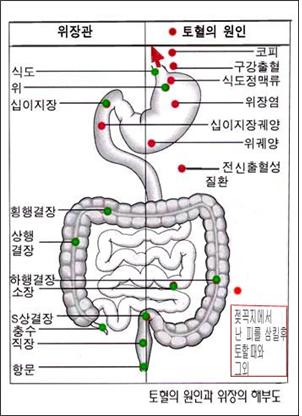
▴ 그림 1-24. 신생아가 피를 토하는 원인과 신생아기 이후 피를 토하는 원인.
분만 중 태어나는 아기가 모체의 산도에서 나온 모체 피를 삼킨 후 태어난 신생아가 피를 토할 수 있고 모유 수유 중 수유모의 젖꼭지에서 나는 엄마의 피를 삼킨 후 신생아가 피를 토할 수 있다.
신생아나 신생아기 이후 코피, 구강 출혈, 식도 정맥류 출혈,위장염, 12지장 궤양, 위궤양, 전신 출혈성 질환 등으로 피를 토 할 수 있다. Copyright ⓒ 2011 John Sangwon Lee, MD., FAAPP
신생아가 피를 토하는 원인
- 태어나서 28일까지의 기간을 신생아기라고 한다.
- 신생아기의 아기들을 신생아라고 한다.
- 태어나서부터 생후 첫 3일까지의 신생아가 피를 토하는 원인의 대부분과 생후 3~4일 이후에서 28일까지의 신생아들이나 신생아기 이후 영유아들, 학령기 아이들, 또는 사춘기 아이들이 피를 토하는 원인의 대부분은 다른 점이 많다. [부모도 반의사가 되어야 한다-소아가정간호백과]-제6권 신생아 성장 발육 양호 질병 -피를 토할 때, 신생아가 출혈할 때 참조).
- 드물게, 갓 태어난 신생아가 비타민 K 결핍증으로 위장 관에서 피가 날 수 있고 위장 관 내로 흘린 피를 토할 수 있다.
- 분만 중 모체의 산도에서 나는 피를 태어나는 아기가 삼킬 수 있다. 산도에서 모체의 피를 삼키고 태어난 신생아가 생후 1~3일 동안 피를 토할 수 있다.
- 모유를 먹는 아기가 엄마의 젖꼭지에서 나는 엄마 피를 삼킨 후 삼킨 엄마 피를 토할 수 있다. 갓 태어난 신생아의 위장 관이 삼킨 엄마의 피로 자극 받고 삼킨 엄마 피를 토할 수 있다.
- 갓 태어난 신생아가 토한 피가 아기 자신의 입안, 인두 강, 비강, 위장 관 등에서 흘린 피를 토하는지, 그렇지 않으면, 분만 중 모체의 산도에서 흘린 모체 피를 삼킨 후 신생아가 삼킨 모체의 피를 토하는지 감별해야한다.
- 분만 중 모체의 산도에서 흘린 모체 피를 삼킨 후 태어난 신생아들의 대부분은, 대개, 생후 1~3일 이내 삼켰던 모체 피를 토하는 것이 보통이다.
- 그렇지 않으면, 태어나는 중 산도에 흘린 모체 피를 삼킨 후 태어난 신생아들의 대부분은 모체 피의 일부를 토하고 나머지는 삼킨 피가 대변으로 배설되기도 하고, 또는 삼킨 모체 피의 전부가 위장 관을 통과한 다음 항문을 통과해 혈변으로 배설된다.
- 원인을 확실히 알 수 없이, 생후 2~3일 경에, 신생아가 한두 방울의 피를 토하다가 자연히 그치는 경우도 있다.
- 위궤양, 십이지장 궤양, 위장염, 선천성 위장 관 기형, 위장 관 내 이물, 위장 관 혈관 기형, 또는 전신 출혈성 질환 등으로 신생아가 피를 토할 수 있다. 그런 경우는 아주 드물다.
신생아기 이후 영유아들이나 학령기 아이들 및 사춘기 아이들이 피를 토하는 원인
- 선천성 담도 폐쇄증이 있을 때,
- 간 정맥의 압이 비정상적으로 높아서 생긴 식도하단 정맥류가 터지면 피를 다량 토할 수 있다. 이런 병으로 소아청소년들이 피를 토하는 경우는 사실 아주 드물다.
- 간 경변증, 혈우병, 패혈증, 혈소판 감소증, 위궤양, 위염, 십이지장 궤양, 십이지장 염, 전신 출혈성 질환, 부식성 식도염, 위장염, 약물 중독, 아스피린 등 약물 부작용, 위장 관 내 이물, 위장 관 혈관 기형, 지속성 구토 등으로 피를 토할 수 있다.
- 신생아기 이후 소아들의 경우, 이를 뺄 때, 아데노이드 절제 수술, 편도 절제 수술을 받을 때 흘린 피를 삼키거나 삼킨 코피로 위장 관이 자극받고 삼킨 피를 토할 수 있다.
토혈의 진단
- 토혈은 어떤 병의 증상 징후이고 병명은 아니다.
- 피를 토할 때는 토한 피가 신체 어느 부위에서 어떻게 해서 나온 피인지 알아봐야 한다.
- 피를 토할 때 토한 피는 구강, 인두, 식도, 위장관 등 소화기계에서 나온 피일수도 있고 상·하기도 등 호흡기에서 나온 피일 수 있다.
- 즉 입안, 인두, 식도, 위, 작은창자 등의 소화기계의 위장관에서 나온 피를 토할 수도 있고, 비강, 인두, 후두, 기관, 기관지, 폐 등의 호흡기에서 나온 피를 토할 수 있다.
- 호흡기 질환을 앓을 때 기침하면서 토한 피는 호흡기에서 나온 피(객혈)일 가능성이 더 많다.
- 소화기 질병을 앓는 중 구토와 구역질을 하다가 토한 피는 소화기의 위장관에서 나온 피(토혈)일 가능성이 더 많다.
- 그렇지만 신생아들이나 영유아들이 피를 토할 때 토한 피가 호흡기에서 나온 피인지, 위장 관에서 나온 피인지 확실히 쉽게 감별하기가 힘들다.
- 배가 아프면서 토한 피, 위궤양이나 십이지장 궤양 등을 앓고 있는 병력이 있으면서 토한 피는 위장 관에서 나온 피일 가능성이 상당히 더 많다.
토혈의 치료
- 토혈의 원인과 토한 피의 량, 토혈할 때의 건강상태, 출혈 스크린 검사, 간 기능 검사 결과 등에 따라 치료가 다르다.
- 갓 태어난 신생아든 그 이후 신생아이든 영유아든 아무런 증상 징후가 없이 피를 토하면 단골 소아청소년과 의사에게 전화 연락해서 그들의 지시에 따라 토혈의 원인이 무엇인지 알아보고 원인에 따라 치료한다.
- 피를 다량으로 토하고 의식이 몽롱하거나 쇼크에 빠질 때는 기본 심폐 소생술 처치법을 하고 상반신을 하반신보다 15~30도 정도 낮게 눕히고 의료구급대, 병원 응급 의료실, 또는 단골 소아청소년과에 긴급으로 전화해 그들의 지시에 따라 응급처치를 현장에서 하면서 구급차나 다른 적절한 교통수단으로 병원 응급실로 급히 이송한다.
- 병원 응급실에서는 토혈의 원인과 정도에 따라 산소호흡치료, 수혈치료를 한다.
- 피가 없어 수혈치료를 할 수 없으면 알부민을 피 대신 쓰기도 한다.
- 토혈의 원인에 따라 치료한다.
Copyright drleepediatrics.com 3/15/2026
Hematemesis (Vomiting Blood)
Overview of Hematemesis
Hematemesis refers to the act of vomiting or spitting out blood that has originated from the gastrointestinal tract. It is a clinical sign, not a specific disease.
For comparison, the act of coughing up or spitting out blood originating from the lower respiratory tract or the lungs is called hemoptysis.
Vomited material may consist of gastric fluid mixed with a few drops of blood, a small amount of pure blood, or a large volume of blood.
Sometimes, the vomited blood may appear “coffee-ground” in color—a sign that can occur whether the amount is small or large.
There are many causes for hematemesis, and these causes vary depending on age.
This section explores the causes of hematemesis in newborns, as well as in infants, young children, school-aged children, and adolescents.
Causes of Hematemesis
▴ Figure 1-24. Causes of hematemesis in newborns and in individuals beyond the neonatal period.
Newborns may vomit blood if they have swallowed maternal blood—either from the birth canal during delivery or from a nursing mother’s bleeding nipple during breastfeeding.
In newborns and older children, hematemesis can also be caused by conditions such as nosebleeds, oral bleeding, bleeding from esophageal varices, gastroenteritis, duodenal ulcers, gastric ulcers, or systemic hemorrhagic disorders. Copyright ⓒ 2011 John Sangwon Lee, MD, FAAPP
Causes of Vomiting Blood in Newborns
The period from birth through the first 28 days of life is called the neonatal period, and infants during this time are referred to as newborns (or neonates).
The causes of vomiting blood in newborns during the first three days of life often differ significantly from the causes seen in infants older than 3–4 days, as well as in older infants, children, school-aged children, or adolescents. (Refer to *Parents Should Also Be Semi-Doctors: Encyclopedia of Pediatric and Family Nursing* – Volume 6: Newborns – Growth, Development, and Illnesses – “Vomiting Blood” and “Bleeding in Newborns.”)
In rare cases, a newborn may experience gastrointestinal bleeding due to a vitamin K deficiency, which can lead to the vomiting of blood that has collected in the digestive tract.
During childbirth, a newborn may swallow blood originating from the mother’s birth canal. If a newborn has swallowed such maternal blood, they may vomit it up during the first 1–3 days of life.
A breastfed infant may swallow blood from the mother’s nipple—if the nipple is bleeding—and subsequently vomit that blood. The newborn’s gastrointestinal tract may also become irritated by the swallowed maternal blood, leading the infant to vomit it back up. When a newborn vomits blood, it is necessary to determine whether the blood originated from the infant’s own body—such as the mouth, pharynx, nasal cavity, or gastrointestinal tract—or if it is maternal blood that the infant swallowed during the birthing process.
In most cases where a newborn has swallowed maternal blood from the birth canal during delivery, the infant will vomit that blood within the first 1 to 3 days of life.
Alternatively, an infant who has swallowed maternal blood during birth may vomit some of it, while the remainder passes through the gastrointestinal tract and is excreted in the stool; in some cases, the entire amount of swallowed maternal blood may pass through the digestive tract and be expelled as bloody stool.
Sometimes, a newborn may vomit a drop or two of blood around the second or third day of life for no clearly identifiable reason, after which the bleeding stops on its own.
Although very rare, a newborn may also vomit blood due to conditions such as gastric or duodenal ulcers, gastroenteritis, congenital gastrointestinal malformations, the presence of a foreign body in the gastrointestinal tract, vascular malformations within the digestive system, or systemic hemorrhagic disorders.
Causes of vomiting blood in infants, children, and adolescents beyond the neonatal period:
In cases of congenital biliary atresia,
a rupture of esophageal varices—caused by abnormally high pressure in the hepatic veins—can lead to the vomiting of a large amount of blood. Such occurrences are, in fact, extremely rare among children and adolescents. Vomiting blood can be caused by conditions such as cirrhosis, hemophilia, sepsis, thrombocytopenia, gastric ulcers, gastritis, duodenal ulcers, duodenitis, systemic hemorrhagic diseases, corrosive esophagitis, gastroenteritis, drug poisoning, adverse reactions to medications (e.g., aspirin), foreign bodies in the gastrointestinal tract, vascular malformations within the gastrointestinal tract, or persistent vomiting. In children past the neonatal period, vomiting blood may also occur if they swallow blood—for instance, following a tooth extraction, an adenoidectomy, or a tonsillectomy—or if they swallow blood from a nosebleed, which then irritates the gastrointestinal tract and is subsequently vomited back up.
Diagnosis of Hematemesis (Vomiting Blood)
Hematemesis is a symptom or sign of an underlying medical condition, not a diagnosis in itself.
When blood is vomited, it is necessary to determine its source and the mechanism by which it originated.
The blood may come from the digestive system—such as the oral cavity, pharynx, esophagus, or gastrointestinal tract—or from the respiratory system, which includes the upper and lower airways.
In other words, the blood could originate from the digestive tract (including the mouth, pharynx, esophagus, stomach, or small intestine) or from the respiratory tract (including the nasal cavity, pharynx, larynx, trachea, bronchi, or lungs).
If blood is vomited while coughing, it is more likely to have originated from the respiratory tract (hemoptysis).
If blood is vomited during episodes of retching or vomiting in the context of a digestive system disorder, it is more likely to have originated from the gastrointestinal tract (hematemesis). However, when newborns, infants, or young children vomit blood, it can be difficult to readily distinguish whether the blood originated from the respiratory tract or the gastrointestinal tract.
If the vomiting of blood is accompanied by abdominal pain, or if there is a known medical history of conditions such as gastric or duodenal ulcers, it is significantly more likely that the blood originated from the gastrointestinal tract.
Treatment for Hematemesis (Vomiting of Blood)
Treatment varies depending on the cause of the hematemesis, the volume of blood vomited, the child’s overall health status at the time, and the results of diagnostic tests—such as bleeding screenings and liver function tests.
If a newborn, infant, or young child vomits blood—even in the absence of other symptoms or signs—you should contact your regular pediatrician and follow their instructions to determine the cause and appropriate treatment.
In cases involving the vomiting of a large amount of blood, where the child appears disoriented or goes into shock, perform basic cardiopulmonary resuscitation (CPR) if necessary. Position the child so that their upper body is 15–30 degrees lower than their lower body. Immediately contact emergency medical services, a hospital emergency department, or your pediatrician; follow their guidance while providing on-site emergency care, and ensure the child is promptly transported to a hospital emergency department via ambulance or another appropriate means of transport.
At the hospital emergency department, treatment—such as oxygen therapy or blood transfusions—will be administered based on the cause and severity of the hematemesis.
If blood is unavailable for a transfusion, albumin may be used as a substitute.
Treatment is tailored to the specific cause of the hematemesis.
Copyright drleepediatrics.com 3/15/2026