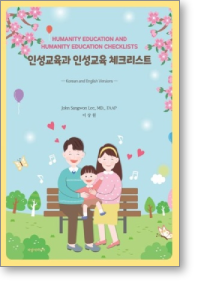
인성교육과 인성교육 체크리스트
Humanity Educational Checklists
저자 : 이상원 (미국 및 한국 소아과 전문의)
출판사 리뷰
나 자신을 사랑하고 부모 형제를 사랑하고 이웃을 사랑하고 부모를 공경하고 하늘과 땅을 두루 살펴볼 때 부끄럼이 없고 남을 도와줄 수 있고 좋은 지덕체를 갖추고 살 수 있게 그리고 건전한 자존심을 갖고 생산적 사회 일원이 될 수 있게 교육하는 것이 인성교육이라고 할 수 있습니다.
이 세상에서 완전한 사람도 하나도 없고 완전한 부모도 하나도 없습니다. 죄를 짓지 않고 사는 사람이 어디 있습니까? 이 세상에서 죄를 짓지 않고 사는 완전한 사람은 하나도 없습니다. 그러나 거기에 가깝게 살아갈 수 있게 교육을 받고 자기 자신도 거기에 가깝게 살아갈 수 있게 연구하고 공부하는 것이 인성교육 과정이라고 할 수 있습니다. 우리 인간은 누구나 이런 인성교육을 태아 때부터 성인이 될 때까지, 더 나아가서는 죽을 때까지 받고 살아야 한다고 생각합니다. 모자란 점이 많이 있지만 여기 있는 인성교육을 많이 이용하면 많은 도움이 될 것으로 믿습니다.
publisher review
To love myself, to love my parents and siblings, to love my neighbors, to respect my parents, to be able to look both heaven and earth without shame, to be able to help others, to live with good moral character, and to be a productive member of society with healthy self-esteem. It can be said that character education is educating people to be able to do it.
There is no perfect person and no perfect parent in this world. Is there anyone who lives without committing sin? There is no perfect person in this world who lives without committing sin. However, it can be said that the character education process involves learning to live close to that place and researching and studying so that you can live close to it yourself. I believe that all of us human beings should receive this kind of character education from the time we are fetuses until we become adults, and even until we die. Although there are many shortcomings, I believe that the character education provided here will be of great help.
─ Contents of The Korean Version ─
제1장. 인성교육을 왜 하나? 인성교육은 무엇이고 언제부터 누가 해야 하나?
제2장. 각종 매디아에서 모은 한국 소아 청소년(0~18세)들의 정황 소개
제3장. 하루에 이런 일들이 미 아이오와주 10대 아이들에게 발생했었다.
제4장. 동방 예의지국 東方禮儀之國에서
제5장. 인성교육 체크리스트 1-11절 : Humanity Educational Checklists 1-11 sections 인성교육 체크리스트
─ 제2절. 인성교육 체크리스트
─ 제3절. 인성교육 체크리스트
─ 제4절. 인성교육 체크리스트
─ 제5절. 인성교육 체크리스트
─ 제6절. 인성교육 체크리스트
─ 제7절. 인성교육 체크리스트
─ 제8절. 인성교육 체크리스트 – 황금률
─ 제9절. 인성교육 체크리스트 – 간디의 7대 죄악이 무엇인지 가르친다.
─ 제10절. 인성교육 체크리스트 – 군자유삼락이 무엇인지 가르친다.
─ 제11절. 인성교육 체크리스트 – 모세 10계명을 가르친다
─ Contents of The English Version ─
Chapter 1. What is humanity education, and when, how, and who should do humanity education in your child’s life?
Chapter 2. May I provide some context on Korean children and adolescents(0-18 years old)
Chapter 3. One day. These things were happening to teenagers in Iowa, USA.
Chapter 4. Humanity Education In the Eastern country with morals, courtesy is standard nowadays
Chapter 5. Humanity Education Section. 1-11
─ Section 1. Humanity Education Checklist
─ Section 2. Humanity Education Checklist
─ Section 3. Humanity Education Checklist
─ Section 4. Humanity Education Checklist
─ Section 5. Humanity Education Checklist
─ Section 6. Humanity Education Checklist
─ Section 7. Humanity Education Checklist
─ Section 8. Humanity Education Checklist – Golden Rule
─ Section 9. Humanity Education Checklist – Teach what Gandhi’s seven great sins are
─ Section 10. Humanity Education Checklist – Teach Gunja Samrak
─ Section 11. Humanity Education Checklist – Teach the Ten Commandments of Moses
ㆍSources and references
drleepediatrics.com
소아과 전문의 이상원 40계명 참조
미국 한국 소아과 전문의 이상원박사의 40계명
이상원 박사는 그의 페이스북에 2022년 10월 26일 ‘어제 우리 집에 모인 집안 식구들에게 알리고 싶었던 이상원 40계명’이라는 글을 남겼다.
어제 우리 집에 모인 집안 식구들에게 알리고 싶었던 이상원 박사의 40계명
단순한 삶의 원칙을 가르친다
대인 관계에서 많이 쓰면 좋은 말들, The short course in human relationship
평소에도 인사하고 특별한 때에도 인사를 잘하면 성공의 길이 훤해집니다.
The 40 Commandments of Dr. Sang-won Lee, an American And Korean Pediatrician
I happened to be exchanging comments with Dr. Sang-won Lee on a Facebook club post about the blessings of a happy new year. I came across his Facebook page and came across a wonderful post I’d like to share.
Dr. Lee currently posts information on pediatrics and family health (nursing) for children and adolescents at www.drleepediatrics.com, written by Dr. Lee, a Korean pediatrician and an American pediatrician.
His homepage clearly states, “Parents should be half doctors, too.” “Parents should be at least half doctors.” His credentials are evident in the fact that he is certified by the Korean-American Pediatrics Board, John Sang-won Lee, MD, FAAP.
Dr. Lee posted on his Facebook page on October 26, 2022, “The 40 Commandments of Dr. Lee I Wanted to Share with My Family at Our Home Yesterday.” Dr. Lee Sang-won’s 40 Commandments, which I wanted to share with the family gathered at my house yesterday:
1. Of course, you should know how to say thank you when someone does something special for you.
2. You should know how to forgive even the smallest offenses, and you should also know how to forgive your siblings seven times out of seven.
3. No one is perfect in this world. If you do something wrong, learn to ask for forgiveness.
4. Learn what love is, what unconditional love is, and don’t commit adultery.
5. Learn how to love with eye contact, physical touch, focused attention, and nurturing love. And do it sincerely.
6. Live frugally and humbly. Don’t slander others.
7. Be frugal with others’ belongings, and of course, be frugal with your own.
8. Know how to greet newborns, children, and the elderly, and when greeting them, usually stand up from your seat.
9. Repay the favor, whether you receive a lot or a little, with material goods, your heart, or both.
10. Depending on the situation, if someone asks if I can help you in any way, and they say yes, then help them.
11. Live without lying in good faith.
12. Do not steal.
13. Until you die, if you are healthy in body and mind, work hard and rest appropriately.
14. Respect your parents. When your parents grow old, monitor their eyesight, hearing, blood pressure, blood sugar, and other health conditions. Buy them nice clothes, take them on trips, and show them your love. Don’t send them to a nursing home.
15. Praise them often for doing a good job.
16. Know your ancestors and the roots of your family well and revere them.
17. Love your siblings and neighbors.
18. Respect and treat your older siblings as if they were your parents.
19. Maintain adequate food, clothing, shelter, health, love, hope, and faith.
20. Love your spouse unconditionally, saying “No Matter What.”
21. Keep your appointments.
22. Live by the Golden Rule.
23. Don’t bear false witness.
24. Read many good books diligently to gain valuable knowledge.
25. Maintain a good heart and good mental health.
26. Don’t smoke.
27. Maintain a healthy weight.
28. Get adequate physical exercise.
29. Eat plenty of vegetables and fruits. 30. Learn good character traits appropriate to your age and situation and become a good person.
31. Don’t pick or pluck flowers indiscriminately.
32. The Bible, Buddhist scriptures, the Analects of Confucius, the Mindfulness Book, and Raising Your Sons and Daughters with Real Unconditional Love (Ross Campbell, translated by Sangwon Lee).
Raise Your Sons and Daughters with Real Unconditional Love (John Sangwon Lee, MD, FAAP, Author, by Dorrance, Published). Raise Your Sons and Daughters with Unconditional Real Love and Humanity, Such as ( Author John Sangwon Lee, published by Yaengsukak)
Humanity Education and Humanity Education Checklists (Sangwon Lee, Parangsae Media Publishing),
Caring for My Beloved Wife Who Had a Stroke (Sangwon Lee, Parangsae Media Publishing),
www.drleepediatrics.com Parents Should Become Half-Doctors, Too. And get more help on parenting, health, disease prevention, and love with 25 ebooks and more.
Teaching the Principles of Simple Living
33. Can you farm successfully without a hoe, shovel, or pickaxe?
34. Can you catch a lot of fish without fishing, nets, or boats?
35. Can you chop wood without a sickle, saw, or axe?
36. Can you study well without textbooks?
37. Can you become a good Christian without studying the Bible?
38. Can you become a good parent without studying from parenting books, websites, etc.?
39. Can a medical or nursing student become a good doctor or nurse without studying hard?
40. It’s difficult for parents to have good children without studying.
Added Post 5/20/2025
Phrases that are good to use frequently in interpersonal relationships: The Short Course in Human Relationships
I was wrong. Please forgive me.
You did a good job.
I’d like to hear your opinion. (What is your opinion?)
Can I help you?
Thank you?
“You or I.” Original author: Unknown
The more we say these words throughout our lives, the healthier and happier we become, and the smoother our interpersonal relationships become.
How important is it to ask for and receive forgiveness when we make a mistake?
How good is it to encourage and praise others for their good deeds?
How good is it to have a life attitude of listening to others, learning from them, and improving rather than insisting on our own opinions and claiming we are the best in the world?
How good is it to be someone who sacrifices for others rather than someone who thinks only about living well, comfortably, and happily?
How good is it to be someone who is grateful not only for small things and all things, but also for the smallest and most insignificant things others do for us.
How good is it to never forget the kindness of our parents and siblings and to live with a grateful heart? It’s great to have a grateful community, but how wonderful it would be to raise children who always respond with words and writing.
How wonderful it would be to live in interpersonal relationships where the word “I” is minimized and “you” is respected.
How wonderful it would be if children and adults spoke these words more often and lived by them.
Readers!
How about teaching your children to speak these words more often in their daily lives?
Greeting others regularly, and even on special occasions, will brighten the path to success.
John Sangwon Lee, MD., FAAP
저작권 drleepediatrics.com 2026년 3월 7일